
Table of Contents
Folding one Dutch Crown by hand takes a steady hand and a few careful tucks. Folding 2,000 before a delivery is where most lines break. The fill goes fast, then the tray sits on the bench while someone works each tip one at a time.
This guide covers how to make Dutch Crown joints by hand, why hand folding caps your output, and how operators close a full row at once to finish 800+ pre-rolls an hour with one person.
Key takeaways
- A Dutch Crown needs a 3 to 5 mm margin of empty paper above a firmly tamped fill. Get the margin wrong and no tool will save the fold.
- By hand, the fold is three or four overlapping tucks plus a final tamp. It works, but every cone is handled individually.
- In an independent test, hand closing more than doubled the time per production cycle.
- Three ways to scale: more people folding by hand, a separate closing machine, or a filling system with the fold tool built in.
- Consistent fill weight comes first. A fold tool presses every cone the same, so uneven fills show up as uneven crowns.
What You Need Before You Fold
A clean Dutch Crown starts before the fold. Four variables decide whether the tip closes flat or collapses:
- Grind. Medium and consistent. Coarse grind leaves voids the fold sinks into; powder packs too dense and draws hard.
- Fill margin. Leave 3 to 5 mm of empty paper above the fill. Less and there is nothing to fold. More and the crown sits on air and caves in.
- Tamp. The fill has to be firm right up to the margin. A soft top layer lets the fold push down unevenly.
- Consistent weight. Every cone in the batch needs the same fill so every margin lands at the same height. A metering tray does this; see how to keep pre-roll weight consistent at scale.
For hand folding you need a flat-ended packing tool, a metal rod or a chopstick with a squared tip. For production, you need a tool that folds many cones at once, covered below.
New to the closure? Start with what a Dutch Crown pre-roll is.
How to Make a Dutch Crown Joint by Hand
- Fill and tamp. Pack the cone firmly until the fill sits 3 to 5 mm below the rim.
- First fold. Press the flat end of your tool against the inside edge of the paper and fold roughly a quarter of the margin down over the fill.
- Crease it. Press down and give the tool a small twist to lock the fold in place.
- Rotate and repeat. Turn the cone and fold the next section so it overlaps the first. Three folds give the cleanest crown; four still look professional.
- Final tamp. Press the flat end of the tool straight down on the center of the crown and twist once to seat it.
- Check it. The top should be flat, even all the way around and firm to a light press. No paper should stand up past the rim.
Done well, this produces the same closure a machine does. The limit is speed: every cone is filled, folded and tamped one at a time.
Where Hand Folding Breaks Down
Filling scales with equipment. Closing scales with headcount. A vibration tray fills 100+ cones in minutes, then each cone waits for a person to close it.
The gap is measurable. In an April 2025 test, Custom Cones USA found that closing by hand can more than double the time per production cycle. That was for twists, the fastest hand closure. A hand-folded Dutch Crown takes more motions per cone than a twist, so the penalty is larger.
Three symptoms tell you closing is your bottleneck:
- Filled trays queue on the bench waiting to be closed.
- Crown quality drops late in the shift as hands tire.
- Adding a second filler does nothing for output; adding a second closer does.
If that sounds like your line, the fix is to stop closing one cone at a time.
Three Ways to Scale Dutch Crown Production
| Approach | How it works | Cones closed per motion | Trade-offs |
|---|---|---|---|
| More hand folders | Add staff to the closing step | 1 | Labor grows with every unit; consistency varies by person |
| Separate closing machine | Filled tray moves to a second machine that folds the whole tray | Full tray per cycle | Second purchase and second station; often matched to one brand’s tray and cone size; some need compressed air |
| Fill system with built-in fold tool | The tray you fill on is the tray you fold on | A full row (11 on the Fill N’ Fold) | Row-by-row rather than whole-tray; no second machine or transfer step |
The right choice depends on volume and floor space. A separate closer suits a line that already owns a compatible filler. A built-in fold tool suits an operator buying their first system or replacing hand closing without adding a station.
If you are still deciding which closure to run at all, Dutch Crown vs twisted pre-rolls covers burn, packaging and shelf performance.
A Production Run on the Fill N’ Fold
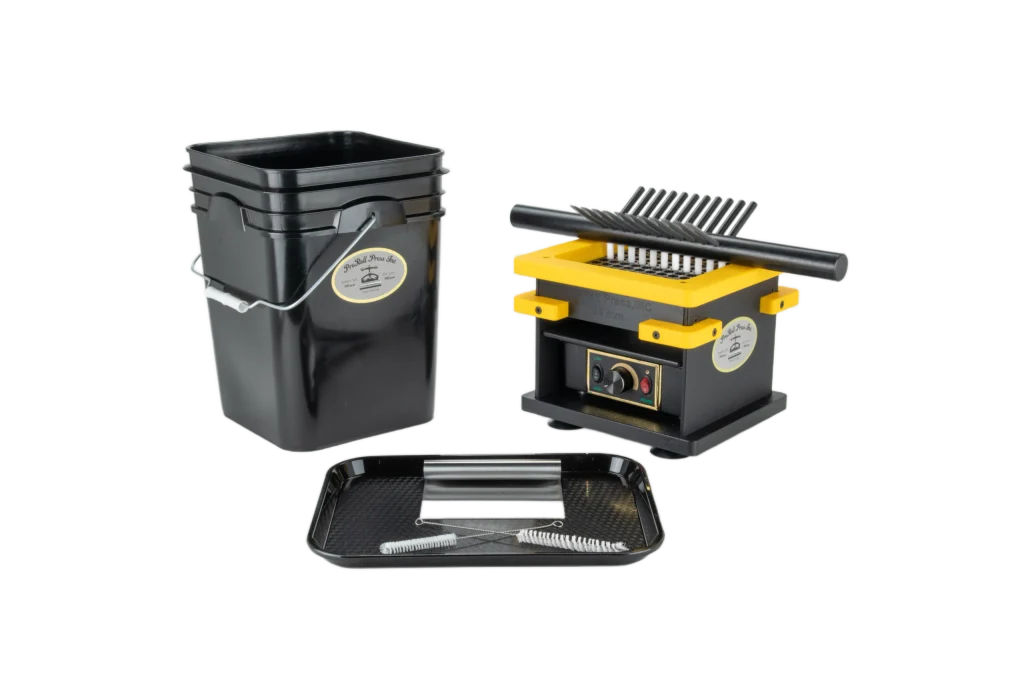
We built the Fill N’ Fold because closing was the step that kept us on the bench at Yield Farms. Here is one 121-cone cycle with one operator:
- Set up the tray. Use the work tray matched to your cone: 84mm (0.5 g), 98mm (0.75 g) or 109mm (1 g). Load 121 cones.
- Dial in the dose. Set fill weight on the color-coded metering tray with its two shim adjustment plates. Do this once per strain and grind, then check-weigh a few cones.
- Fill. Load ground flower into the metering tray and drop it into the cones.
- Settle. The vibrating packing base settles material evenly down each cone. Scrape off any excess.
- Fold the first row. Place the press tool across a row of 11 filled cones and turn it once. That one motion tamps the fill and folds all 11 tips into a Dutch Crown.
- Repeat across the tray. Eleven rows, eleven turns.
- Inspect and unload. Spot-check crowns, then pull the finished pre-rolls for packaging.
One operator clears the full tray in under 10 minutes. In the Custom Cones USA single-operator test, the Fill N’ Fold averaged 837 finished Dutch Crown pre-rolls per hour, and 1,361 per hour with a second operator and spare parts.
The press tool ships in every package, so there is no separate closer to buy or station to staff. See Fill N’ Fold pre-roll machines for tray options.
Quality Control and Troubleshooting
A fold tool presses every cone the same way, so problems in the fill show up in the crown. Use this table to trace a bad crown back to its cause.
| Problem | Likely cause | Fix |
|---|---|---|
| Crown caves in or sits low | Margin too deep, or soft fill at the top | Raise fill weight or tamp harder before folding |
| Paper won’t fold, tears at the edge | Margin too shallow | Lower fill weight to restore 3 to 5 mm of paper |
| Crowns at different heights across a row | Uneven fill weight | Re-check metering plates; check-weigh 5 cones per tray |
| Fold opens after closing | Grind too coarse or flower too dry to hold a crease | Tighten grind; check moisture |
| Hard draw | Fill packed too dense or grind too fine | Back off tamp pressure; coarsen grind slightly |
Per-tray QA check
- Check-weigh 5 cones from different rows
- Look across each row: crowns flat and level
- Press 3 crowns lightly: they hold
- Burn-test 1 pre-roll per batch for an even, centered burn
Frequently Asked Questions
How do you make a Dutch Crown joint?
Fill and tamp a cone so 3 to 5 mm of paper is left empty at the top. Fold that margin over the fill in three or four overlapping sections with a flat-ended tool, then tamp the center of the crown flat. At production volume, a press tool folds a full row of cones in one motion.
How much paper do you leave for a Dutch Crown?
Leave 3 to 5 mm of empty paper above the fill. Less leaves nothing to fold. More leaves the crown sitting on air, and it caves in.
Is a Dutch Crown slower to make than a twist?
By hand, yes. A Dutch Crown takes more motions per cone than a twist. With a fold tool that closes a full row at once, Dutch Crown production is faster than twisting by hand.
Do I need a separate machine to make Dutch Crown pre-rolls at scale?
Not necessarily. Some lines add a separate closing machine after the filler. Others use a filling system with the fold tool built in, such as the Fill N’ Fold, which folds 11 cones per turn on the same tray they were filled on.
Why do my Dutch Crowns come out uneven?
Uneven crowns almost always trace back to uneven fill weight. If cones in a row hold different amounts, the paper margins land at different heights and the fold presses each one differently. Fix the dose first.
Next Step
If closing is the step holding your line back, the Fill N’ Fold folds 11 Dutch Crown tops per turn and clears a 121-cone tray in under 10 minutes, with no separate closer. Compare pre-roll machines and pricing, or talk to our team about the right tray for your cone size. For a wider look at equipment tiers, read the pre-roll cone filling machine guide.