
Table of Contents
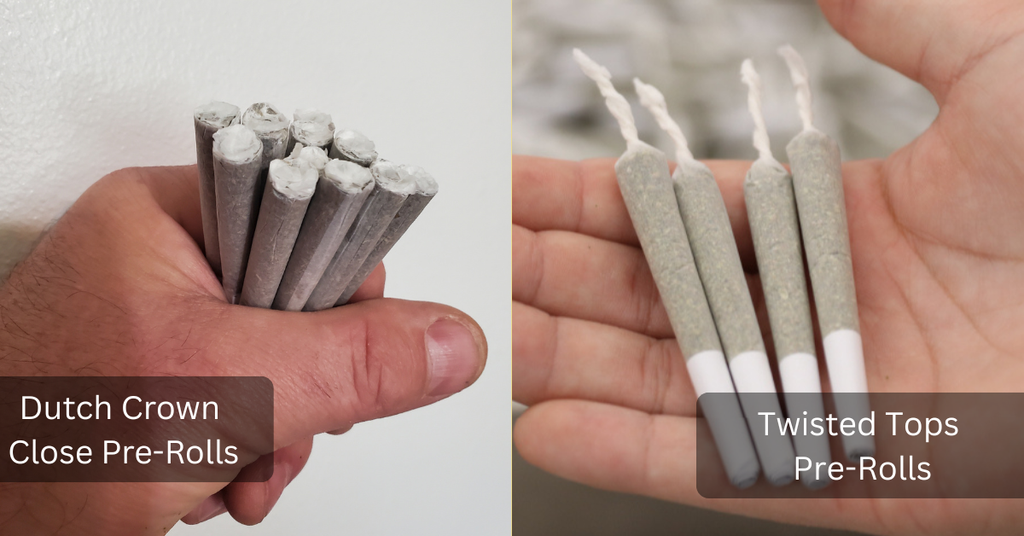
Two pre-rolls sit side by side in a dispensary case. Same strain, same weight, same paper. One has a flat, folded top. The other ends in a curl of twisted paper. The buyer reaches for the flat one, and most can’t say why.
The answer to Dutch Crown vs twisted pre-roll comes down to three things: how the tip lights, how it survives the package, and how many labor hours it takes to close. For product headed to a retail shelf, the Dutch Crown wins on all three once you close with a tool. The twist still earns its place in small, hand-rolled batches.
Key takeaways
- A Dutch Crown folds the top paper flat onto the fill. A twist spins it into a wick.
- A flat top lights evenly across its whole face. A twist lights paper first and can start the cherry off-center, one known cause of canoeing.
- Folded tops are shorter and hold their shape in tubes and tins. Twists bend, flatten and unwind.
- Closing is the slowest step on most filling lines. In an independent test, a fold-a-row tool finished 837 pre-rolls per hour; hand-twisted lines finished 529 to 585.
- No closure fixes a bad fill. Grind, moisture and packing density still decide most of the burn.
What Is a Dutch Crown Top?
A Dutch Crown is a closure made by folding the empty paper above the fill inward and pressing it flat. Nothing is twisted and nothing protrudes. The result is a structured cap sitting directly on packed flower.
The cone is filled to 3 to 5 mm below the rim. That margin is folded over the fill in three or four overlapping sections and tamped. By hand, it takes a flat-ended tool and several motions per cone. With a press tool, a full row folds and tamps in one motion.
For the full anatomy and history, read what a Dutch Crown pre-roll is.
What Is a Twist Pre-Roll Top?
A twist pre-roll is closed by pinching the paper above the fill and spinning it into a wick, usually 6 to 12 mm long. It is the oldest closure in the category and needs no tool, so most hand-rolled product and most cones closed off a basic filling tray end this way.
Its weakness is variation. Twist tension, wick length and the pocket of empty paper under the twist change from operator to operator, and from the first hour of a shift to the last.
Dutch Crown vs Twisted Pre-Roll: Side-by-Side
| Factor | Dutch Crown top | Twisted top |
|---|---|---|
| Shape | Flat, folded cap | Spun paper wick |
| Paper above the fill | 3 to 5 mm, folded in | 6 to 12 mm, twisted out |
| First light | Flame meets a flat, even face | Wick burns first, then the fill catches |
| Canoeing risk from the tip | Lower: centered start | Higher when the twist is loose or off-center |
| Unit-to-unit consistency | Set by the tool | Set by the operator’s hands |
| In tubes and tins | Shorter, holds shape | Longer, bends or unwinds |
| Shelf read | Uniform, machine-finished | Variable, hand-finished |
| Closing by hand | Slower per cone | Fastest hand method |
| Closing with a tool | A full row per motion | Still one cone at a time |

Lighting, Burn and Canoeing
The first few seconds after ignition set the burn line for the whole pre-roll. A twist puts a wick of bare paper between the flame and the flower. The paper flares, burns down unevenly, and lights whichever side of the fill it reaches first. An off-center twist means an off-center cherry.
A Dutch Crown has no wick. The flame meets a flat face of paper backed by packed flower, so the whole circumference catches at once. That removes tip construction as a cause of canoeing. The other causes are covered in what causes pre-rolls to canoe and how to fix it.
The limit is real: a closure cannot rescue a bad fill. Uneven grind, wet flower or air pockets will canoe under either top. A tight twist on a well-packed cone will outburn a Dutch Crown on a loose one.
Production: Closing Sets Your Line Speed
Any vibration tray fills cones fast. The hours go into closing. A twist takes seconds per cone, but every cone is handled one at a time, so a 1,000-unit day means 1,000 separate twists.
A fold tool changes that. In an April 2025 test, Custom Cones USA timed three cone filling machines with one operator each:
| Machine | Cones per cycle | Closure | Finished pre-rolls per hour |
|---|---|---|---|
| Fill N’ Fold | 121 | Dutch Crown, folded by tool | 837 |
| King Kone | 169 | Twisted by hand | 585 |
| Knockbox 100 | 100 | Twisted by hand | 529 |
The King Kone tray holds 48 more cones per cycle and still finished 252 fewer pre-rolls per hour. The gap is the closing step. The report notes King Kone has since released a separate closer that narrows it, which makes the same point: closure method, not tray size, sets throughput.
Consistency follows the same rule. A tool applies the same fold and the same tamp pressure to every cone in the row. Hands drift by hour six.
For the full workflow, see how to make Dutch Crown joints at scale.
Packaging and Shelf: What the Buyer Sees
A twisted top adds length and a weak point. In a tube, the wick bends against the cap. In a multipack tin, it flattens or unwinds and drops loose material into the package. A Dutch Crown has nothing sticking out, so a row of them sits at one height and arrives the way it left your facility.
On the shelf, the tops send different signals. A twist reads as hand-finished. A Dutch Crown reads as machine-finished, with every unit identical. Budtenders notice, and a budtender’s recommendation moves more pre-rolls than the label does.
For a dispensary buyer vetting a new supplier, the tip is a quick proxy. A producer who controls the closure that tightly is likely controlling weight and density too.
Which Closure Should You Run?
| Your operation | Run | Why |
|---|---|---|
| Hand-rolling under 100 a day, sold direct | Twist | No tool needed; a careful twist holds up at that volume |
| Filling on a tray, closing by hand | Dutch Crown | Closing is your slowest step, and a fold tool removes it |
| Selling into dispensaries | Dutch Crown | Uniform tips, cleaner packaging, stronger shelf read |
| Buying from a new supplier | Prefer Dutch Crown | Signals process control; still verify weight and burn |
The twist is not wrong. It fits low volume where one careful person finishes every unit. Past that, it costs more labor for less consistency, and a commercial pre-roll machine with a fold tool pays for the switch.
How the Fill N’ Fold Makes Dutch Crown Tops
We closed cones by hand at Yield Farms before we built this machine, and the fold was the step we wanted gone. The Fill N’ Fold press tool sits across a row of 11 filled cones. One turn tamps the fill and folds every tip in that row. Eleven rows clear a 121-cone tray in under 10 minutes with one operator.
The press tool ships in every package, so Dutch Crown is the system’s standard output, not an upgrade. Several other filling systems reach a folded top by adding a separate closing machine as a second purchase and a second station. Fill N’ Fold pre-roll machines start at $1,850.
Comparing equipment? The pre-roll cone filling machine guide covers tray sizes, output tiers and what to check before you buy.
Frequently Asked Questions
What is the difference between a Dutch Crown and a twist pre-roll?
A Dutch Crown is closed by folding the top paper inward and pressing it flat. A twist pre-roll is closed by spinning the top paper into a wick. The Dutch Crown is shorter, flat-faced and uniform. The twist is faster by hand but varies from unit to unit.
Do Dutch Crown pre-rolls burn better than twisted pre-rolls?
A Dutch Crown presents a flat face to the flame, so the cherry starts centered. A twist burns its paper wick first and can start off-center. That makes a Dutch Crown less likely to canoe from the tip, though grind, moisture and packing density matter more than the closure.
Why do dispensaries prefer Dutch Crown pre-rolls?
Dutch Crown tips look identical across a batch, sit at one height in the package and don’t bend or unwind in transit. Buyers and budtenders read that uniformity as a sign of a controlled production line.
Can you make a Dutch Crown by hand?
Yes. Leave 3 to 5 mm of empty paper, fold it over the fill in three or four sections with a flat-ended tool, then tamp. It takes longer per cone than a twist, which is why producers past a few hundred units a day close with a press tool or closing machine.
Is a twisted top ever the better choice?
For small hand-rolled batches sold direct, a careful twist works and needs no equipment. For product filled on a tray and sold at retail, a Dutch Crown is faster to produce with a tool and more consistent on the shelf.
Next Step
If closing is the slowest step on your line, the Fill N’ Fold folds 11 Dutch Crown tops per turn and clears 121 cones in under 10 minutes. Compare pre-roll machines and pricing, or talk to our team about the right tray for your cone size.