 Skip to content

A pre-roll can look perfectly made and still burn unevenly. When one side advances faster than the other, leaving a long strip of unburned paper and material, the problem is commonly called pre-roll canoeing. It can waste product, interrupt the experience, and raise questions about consistency.
Quick answer: Pre-rolls can canoe because of uneven packing, inconsistent particle sizes, differences in material moisture, paper or seam irregularities, uneven initial lighting, external airflow, or an inconsistent tip closure. One incident does not necessarily mean the product was manufactured poorly; recurring problems deserve a closer look.
This guide explains the causes of canoeing, what to do when a burn becomes uneven, and how commercial producers can investigate problems before they reach customers. It also shares the firsthand production experience that shaped the PreRoll Press Fill N Fold system.
Table of Contents
A pre-roll can look perfectly made and still burn unevenly. When one side advances faster than the other, leaving a long strip of unburned paper and material, the problem is commonly called pre-roll canoeing. It can waste product, interrupt the experience, and raise questions about consistency.
Quick answer: Pre-rolls can canoe because of uneven packing, inconsistent particle sizes, differences in material moisture, paper or seam irregularities, uneven initial lighting, external airflow, or an inconsistent tip closure. One incident does not necessarily mean the product was manufactured poorly; recurring problems deserve a closer look.
This guide explains the causes of canoeing, what to do when a burn becomes uneven, and how commercial producers can investigate problems before they reach customers. It also shares the firsthand production experience that shaped the PreRoll Press Fill N Fold system.
What Is Pre-Roll Canoeing?

Canoeing is an uneven burn pattern in which one side of a pre-roll burns noticeably faster than the other. Instead of advancing around the circumference in a relatively uniform ring, the burn line slopes down one side, resembling the elongated shape of a canoe.
An uneven burn can result in wasted material, an inconsistent draw, or interruptions during use. However, appearance alone cannot identify the cause. A poorly lit pre-roll may canoe even if it was constructed consistently; a neatly finished cone may canoe because its internal density varies.
For manufacturers, the useful question is not simply whether a pre-roll can canoe. It is whether the problem recurs across particular batches, cone lots, products, or production conditions.
Why Do Pre-Rolls Canoe? Seven Common Causes

Several variables influence combustion. The following are common contributing factors rather than a checklist for diagnosing any single pre-roll with certainty.
1. Uneven packing density
Material does not always settle uniformly inside a cone. Some areas may be compressed while others contain loose sections or voids. These differences can change airflow and how combustion advances through the product.
Packing more tightly is not necessarily better. Excessive compression can restrict the draw; insufficient packing can leave unstable or unevenly distributed material. The goal is a repeatable structure appropriate to the material and cone, not maximum pressure.
2. Inconsistent grind and particle size
A mixture of large fragments and excessive fine particles can distribute unevenly. Larger pieces may leave gaps, while too many fines can compact densely and impede airflow.
There is no universally ideal grind for every pre-roll. Producers should evaluate an appropriate and consistent particle-size distribution for their material, cone specifications, and equipment rather than assuming a finer grind will always produce a better burn.
3. Uneven initial lighting
If one side of the tip ignites more completely than the other, the burn may begin unevenly. This can happen when heat is concentrated on one part of the paper or the pre-roll is exposed to an uneven airflow during lighting.
A balanced initial ignition may reduce this particular cause, but it cannot correct major internal inconsistencies in packing or material distribution.
4. Moisture differences
Moisture can influence how material handles and burns. Very dry material may break into additional fines during preparation, while material with higher moisture may behave differently during combustion. Variation within or between batches can complicate consistency.
Moisture content, water activity, and ambient relative humidity are different measurements. Each can inform material or storage checks, but none describes the complete burn behavior of a finished pre-roll. Commercial producers should use appropriate, validated methods when evaluating material condition.
5. Paper quality and cone construction
Paper thickness, porosity, seam construction, adhesive application, and cone dimensions may influence performance. Damaged paper or irregular seams can add another source of variability.
For facilities purchasing pre-made cones in volume, changes in supplier, product specification, or lot should trigger compatibility checks rather than an assumption that all cones will behave alike.
6. Wind, airflow, and handling conditions
Direct wind or uneven external airflow can cause one side to burn differently, even when the pre-roll is otherwise well formed. Rough handling, deformation, and changes during storage can also complicate an assessment of product quality.
A single incident under unusual conditions should not be treated as conclusive evidence of a manufacturing defect.
7. Irregular tip closure
A twisted tip and a folded Dutch Crown create different shapes at the lighting end. Excess paper concentrated on one side, a distorted fold, or an unevenly finished tip may affect the initial ignition surface.
A consistent closure can reduce variation in appearance and shape. It should be considered alongside packing, paper, and material preparation rather than evaluated in isolation.
How to Fix a Pre-Roll That’s Already Canoeing
If an uneven burn develops, first consider the circumstances. An imbalance that begins immediately may be associated with ignition or wind. A problem that repeatedly appears farther along the pre-roll may prompt questions about material, paper, or packing—although its timing alone cannot establish the cause.
Check for uneven ignition
Look for an initial burn that advanced much farther on one side. Avoid continually exposing the already fast-burning side to additional heat. A minor initial imbalance may become less pronounced as the burn progresses, but not every canoe can be corrected during use.
Reduce the effect of wind
A more sheltered environment can help distinguish an external airflow problem from a recurring product issue. If the same product behaves differently under different conditions, record that observation rather than assuming the manufacturing process caused it.
Recognize a recurring structural issue
If uneven burning persists or returns, there may be a construction or material variable that cannot be resolved by lighting technique. For commercial producers, repeated complaints are a reason to examine batch records and representative samples—not to recommend consumer workarounds as a substitute for quality control.
How to Prevent Canoeing Before Lighting
Some simple checks help identify damage, storage issues, and avoidable variations before lighting.
Inspect the pre-roll
Look for torn or crushed paper, obvious bends, loose sections, and irregular tip closures. Visual inspection can reveal physical damage, but it cannot confirm whether material inside the cone is evenly distributed.
Preserve the product’s structure
Avoid rough handling or squeezing that may deform the cone or change internal packing. Manufacturers should also consider what happens after finishing: transfer to packaging, shipping, and storage may alter a product that looked consistent at the press.
Maintain appropriate storage conditions
Packaging and storage procedures should protect paper and material from unsuitable temperature, moisture, and physical handling. Producers should validate conditions for their particular products rather than rely on a universal humidity figure as a cure for canoeing.
Evaluate patterns, not one-off experiences
A single uneven burn may reflect lighting or environmental conditions. Multiple similar complaints involving the same product, material batch, cone lot, or production shift provide stronger reason for a process investigation.
Why Commercial Pre-Rolls Canoe During Production

Commercial production adds a challenge that is easy to underestimate: products can have the same target fill weight and nearly identical appearance while differing internally. Improving repeatability requires attention to the entire sequence, not only the finishing step.
Material preparation comes first
Particle-size distribution, fines content, moisture characteristics, and bulk density affect how prepared material moves and settles. Different batches—or even poorly mixed portions of the same batch—may respond differently to the same workflow.
Facilities should document relevant material characteristics and reassess their process when the input material changes. One preparation setting should not be assumed to suit every product.
Filling and metering affect distribution
Consistent filling helps reduce the chance that material concentrates disproportionately near the filter or the lighting end. Metering trays can support a repeatable method of distributing prepared material across multiple cones.
However, volumetric metering does not guarantee equal fill weight or internal density. The same measured volume can weigh differently when bulk density varies, so calibration and verification remain important. The PreRoll Press guide to metering trays explains their role within a production workflow.
Packing needs a validated balance
After filling, the material must be packed consistently without creating excessive restriction or loose pockets. The suitable result depends on the product, cone, material, and required specifications. Instead of equating more pressure with better quality, producers should assess packing alongside fill weight and draw characteristics.
Cones and work trays must be compatible
Differences in cone length, taper, filter positioning, or paper construction can affect how cones sit in a work tray and respond to subsequent operations. Supplier or size changes are opportunities to verify fit, positioning, and the quality of the finished product.
The guide to pre-roll cone filling machines offers broader background on equipment configurations and workflow choices.
Closing and handling complete the process
A consistent finish helps standardize the external shape of the tip. PreRoll Press’s Fill N Fold systems use dedicated work trays and mechanical tools to support operator-controlled filling, packing, and Dutch Crown finishing. Relevant configurations may incorporate metering equipment.
The purpose is to make each step easier to repeat, rather than relying on each operator to develop a different technique. Finished-product inspection remains part of that workflow.
Why We Engineered Fill N Fold to Address Canoeing

At PreRoll Press Inc., the thinking behind Fill N Fold comes from much more than an interest in faster machinery. Our experience spans decades in the cannabis industry, including owning and operating cannabis farms and firsthand familiarity with what makes a pre-roll enjoyable—or frustrating—to use.
We knew the problem before we set out to engineer the system. An uneven-burning pre-roll is not merely a cosmetic defect: it can undermine the experience even when the flower itself is excellent. That is why our focus has been on the production stages where an operator can make the greatest difference: distributing material, packing consistently, keeping cones correctly positioned, and finishing each pre-roll in a repeatable way.
Fill N Fold brings those operations together through dedicated work trays, compatible metering options, mechanical packing tools, and Dutch Crown finishing. It is an operator-controlled process, designed to make repeatability part of the workflow rather than something left entirely to individual technique.
In our own production facility, we have never encountered canoeing with pre-rolls produced using Fill N Fold.
That is our firsthand experience, not a claim drawn from a controlled comparative study. It is also why we believe manufacturers should take canoeing seriously as a production-quality issue—not simply dismiss it as something consumers must tolerate. Other facilities should still evaluate performance with their own materials, cone specifications, and handling conditions.
The engineering philosophy is straightforward: build consistency into the process from filling through finishing. A faster production cycle matters, but the quality of the finished pre-roll matters just as much.
If you’re evaluating a new production setup, explore the Fill N Fold commercial pre-roll machine systems and consider how each stage fits into your own quality standards.
Commercial Quality Control: What to Check and Record

Quality control should help operators investigate recurring defects, not merely verify that a batch looks neat. A practical process includes checks before, during, and after production, with acceptance criteria appropriate to each product.
Before filling
Record the material batch and cone supplier or lot. Check material preparation for unusual particle sizes, excessive fines, and any relevant material-condition measurements. Verify that the chosen cone size is compatible with the work tray and production setup.
During production
Use an appropriate sampling procedure to verify fill weights and monitor the filling and packing process. Where equipment is volumetric, periodically check the actual mass delivered. Investigate recurring differences across tray positions rather than assuming the metering step eliminates them.
After finishing
Inspect representative samples for crushed cones, damaged seams, inconsistent closures, and other visible defects. Where suitable, use validated non-contact draw-resistance checks. Inspection procedures should not contaminate products intended for sale.
When investigating burn complaints
Use controlled, documented evaluations on representative samples with suitable safety, ventilation, and regulatory safeguards. Record whether an imbalance appeared at ignition or later, which product or lot was tested, and whether the same result recurs. An isolated test does not establish batch-wide performance or identify a cause conclusively.
A useful production record can include date and batch ID, material lot, cone lot, product size, equipment configuration, sampling results, observed defects, and corrective actions. When a pattern emerges, compare affected and unaffected production runs to identify the variables worth testing.
Canoeing Troubleshooting: Symptoms and Possible Causes
The pattern can suggest where to look, but it should not be treated as a definitive diagnosis.
| Observed problem | Possible contributors | What to investigate |
|---|---|---|
| Uneven burn begins at lighting | One-sided ignition, wind, irregular tip | Lighting conditions, closure shape, paper condition |
| Burn becomes uneven halfway through | Nonuniform fill, packing differences, material variation | Filling records, draw checks, material batch |
| Uneven burn repeatedly follows a seam | Paper or adhesive irregularity, uneven ignition | Cone lot, seam integrity, comparative samples |
| Product draws with unusual resistance | Excessive compaction, high fines content | Grind, packing settings, non-contact draw test |
| Cone feels loose or visibly deformed | Insufficient packing, settling, handling damage | Fill distribution, transfer and packaging steps |
| Many products in one batch show the same issue | Shared material, paper, process, or storage variable | Batch records and controlled comparisons |
| Problem begins after changing cone suppliers | Changes in dimensions, paper, or equipment compatibility | Supplier specifications, tray fit, sample testing |
When to escalate: Repeated defects across the same SKU, batch, cone lot, or production setup warrant a documented investigation. Record what changed and verify whether a corrective action actually improves representative samples before treating the issue as resolved.
Does Dutch Crown Finishing Prevent Canoeing?
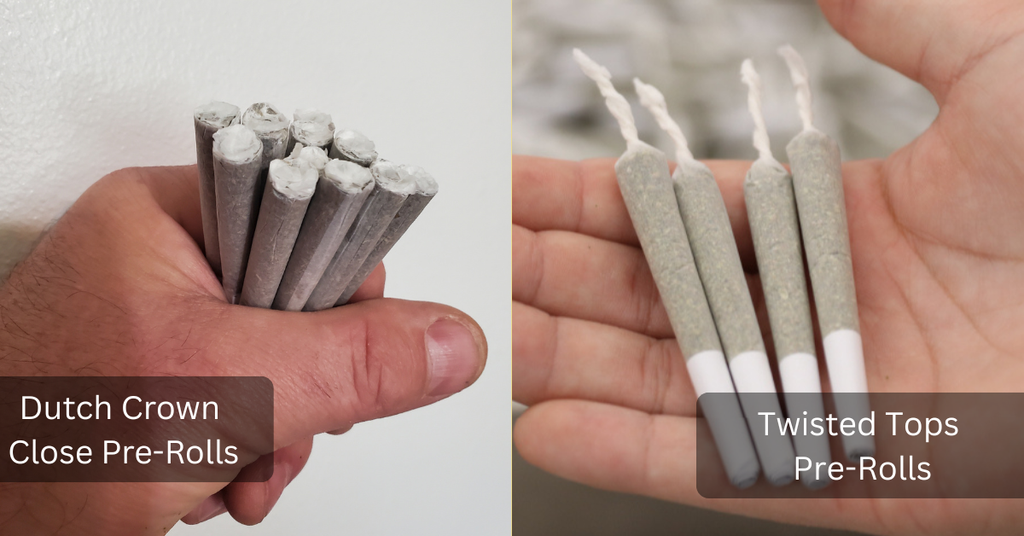
A traditional twisted tip gathers the extra paper into a point. A Dutch Crown folds the open end into a generally flatter finish. These designs change the shape and paper distribution at the lighting end, so finishing consistency is relevant when assessing the initial ignition surface.
A repeatable Dutch Crown process helps standardize the appearance and geometry of the closure. Our own experience with Fill N Fold has been free of canoeing, but the folded finish is just one part of the system. Packing, material characteristics, paper, and lighting still matter when comparing outcomes across facilities.
The practical question for operators is whether the selected closure can be produced consistently and performs acceptably with their actual paper, material, and process. For a fuller explanation, see what a Dutch Crown pre-roll is and how it differs from a twisted closure.
Do Infused Pre-Rolls Canoe More Easily?
Infused pre-rolls add formulation variables beyond those found in flower-only products. Concentrates can differ in viscosity, distribution, and behavior when heated. A concentrated area of infused material may behave differently from a nearby flower-only area, but that does not mean every infused product is inherently more likely to canoe.
An infused SKU should be evaluated against its own specifications, including formulation consistency, draw characteristics, finished-product weight, and burn-quality observations. Manufacturers should not assume that a quality-control procedure validated on flower-only products automatically applies to an infused formulation.
For more context on the category, see the guide to infused pre-rolls.
Frequently Asked Questions About Pre-Roll Canoeing
Why does my pre-roll canoe even when I light it evenly?
The initial light is only one possible factor. Inconsistent packing, material characteristics, paper variation, or handling may also contribute. If the issue recurs across several pre-rolls, consider patterns rather than assuming the user caused it.
Why does a pre-roll start canoeing halfway through?
An uneven burn can emerge later because conditions vary along the length of the cone or the environment changes. Timing is a clue, not proof of a particular manufacturing defect.
Can a pre-roll be packed too tightly?
Yes. Excessive compression may restrict airflow, while insufficient packing may leave gaps. An appropriate and repeatable packing method is more useful than simply applying maximum pressure.
Does a finer grind always prevent canoeing?
No. Excessive fines may compact densely, and oversized pieces may distribute unevenly. Consistency and suitability for the specific product matter more than a universal particle size.
Can the paper seam cause uneven burning?
Seam construction and adhesive consistency may be contributing factors. A burn near the seam does not prove the seam caused it; recurring patterns across cone lots should be investigated with comparisons.
Does Dutch Crown finishing help prevent canoeing?
A consistent Dutch Crown helps make the lighting-end closure more uniform. PreRoll Press has not encountered canoeing in its own Fill N Fold production experience, but that observation reflects the complete workflow—not a separate, controlled test of the fold alone.
How can manufacturers reduce recurring canoeing complaints?
Track complaints by batch, material, cone lot, and equipment setup; inspect representative samples; and use documented evaluations to test plausible causes. The goal is to identify what is changing and keep finished-product quality consistently high.
The Bottom Line: Stop Treating Canoeing as an Unavoidable Production Problem
An uneven burn can start with lighting or weather, but when canoeing happens repeatedly, manufacturers should look closely at material preparation, filling, packing, paper, closing, and handling. A good-looking pre-roll is only the beginning; consistency should be part of the process that creates it.
Our own experience with Fill N Fold has shaped a clear conviction: manufacturers should not accept canoeing as business as usual. We have not encountered it in our production facility with pre-rolls made using the system, and we engineered the workflow around the same variables operators need to control every day.
If you’re looking beyond production speed toward a more repeatable finished product, explore the Fill N Fold pre-roll machines and see how the system supports filling, packing, and Dutch Crown finishing.