
An automated pre-roll machine runs filling and closing with little hand work, and prices run from $200,000 to more than $400,000. A tray system such as the Fill N' Fold fills, packs and closes 121 cones per batch with one operator, for a small fraction of that price. Which one fits depends on your monthly volume. The math is below.
Key takeaways
- On a tray system, one tray holds 121 cones and one press closes 11 pre-rolls with a Dutch Crown.
- In a Custom Cones USA test, one operator averaged 837 Dutch Crown pre-rolls an hour on a Fill N' Fold.
- Fully automated pre-roll machines cost $200,000 to $400,000 and up, according to Custom Cones USA.
- At 50,000 pre-rolls a month, fill-and-close labor on a tray system comes to about $1,241 a month at the U.S. median wage for filling machine operators.
- A tray system does not weigh each cone or package the finished pre-roll. Some automated lines do both.
In this guide
- Automated vs tray system: the difference
- How a tray system works
- How an automated machine works
- Side-by-side comparison
- Pre-rolls per hour
- Cost per pre-roll
- Break-even volume
- Costs a quote leaves out
- Cone sizes and strain changes
- Material prep
- Automating part of a tray system
- When a tray system is the wrong choice
- Which one fits your volume
- Questions to ask before buying
- Glossary of terms
- Frequently asked questions
What is the difference between an automated pre-roll machine and a tray system?
The difference is who moves the cones. On an automated machine, the machine loads, fills and closes each cone while a person tends it. On a tray system, one operator moves a whole tray of cones through each step by hand.
Our guide to pre-roll cone filling machines covers the wider field. Tray systems sit between hand filling and full automation. Some sellers call them manual machines and some call them semi-automatic. This article compares the two options an operator most often has to choose between.
Fully automated machines cost $200,000 to $400,000 and up, according to Custom Cones USA's guide to automated pre-roll machines. The same guide puts the point where buying one starts to make financial sense at about 50,000 pre-rolls a month.
| Hand filling | Tray system | Automated machine | |
|---|---|---|---|
| Who moves the cones | A person, one cone at a time | One operator, a full tray at a time | The machine |
| What the person does | Fills, packs and twists each cone | Loads the tray, runs each step, presses the close | Loads material and cones, watches the machine |
| Equipment price | Little or none | From $1,850 to $6,700 for a complete Fill N' Fold system | $200,000 to $400,000 and up, per Custom Cones USA |
| Usual place in a business | Samples and very small runs | Starting a line through steady commercial volume | High, steady volume in few sizes |
How does a tray system work?
A tray system treats 121 cones as one batch from loading to ejecting. Nothing is done one cone at a time.
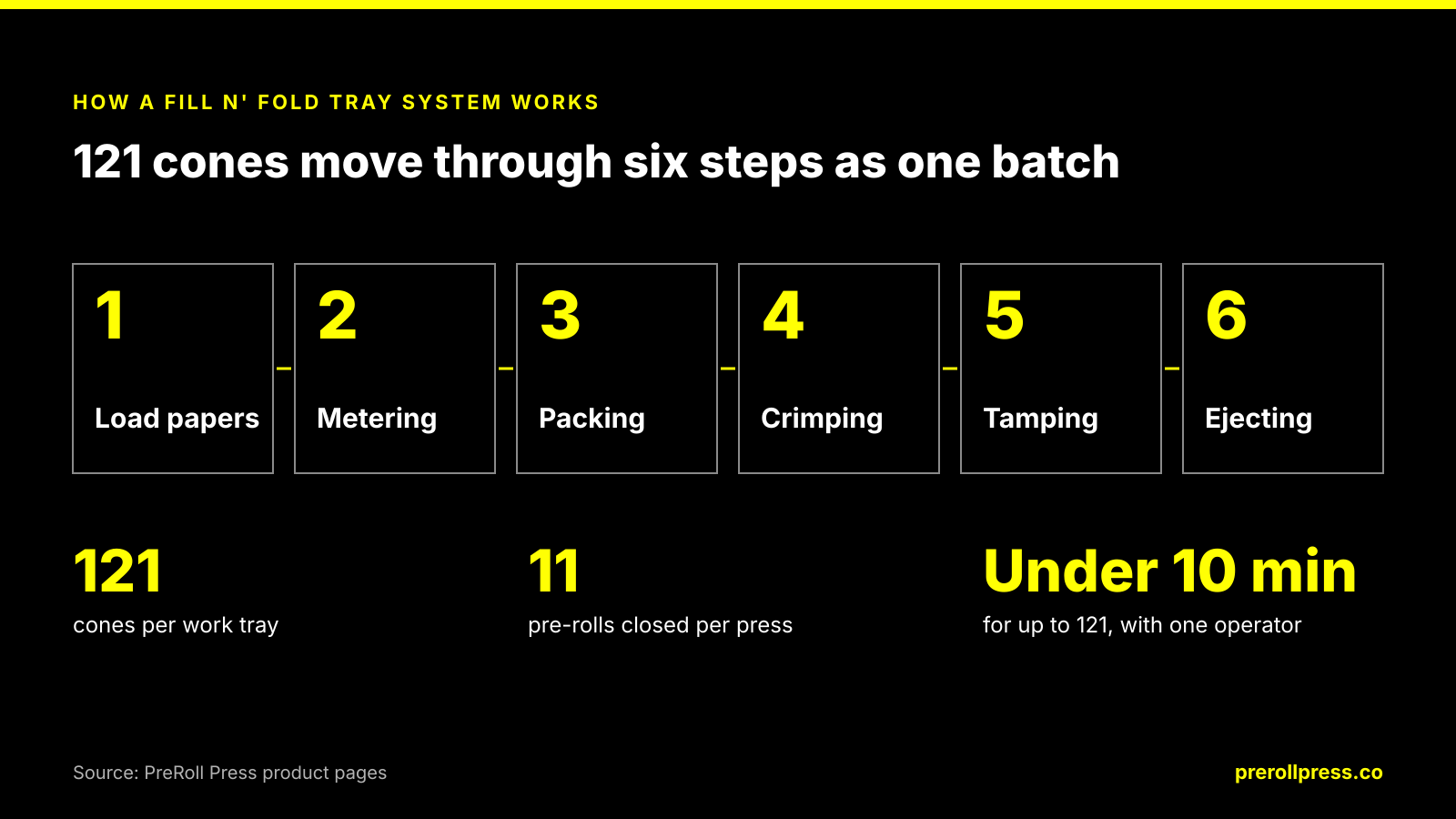
On the Fill N' Fold, the batch moves through six steps: load papers, metering, packing, crimping, tamping and ejecting.
The Fill N' Fold Work Tray holds 121 cones of a single size. The adjustable metering tray fills all 121 cones to the same volume in one pass. The Fill N' Fold Packing Base settles the material in every cone to the same density.
Closing is the slow step when every cone is twisted by hand. The press tool that crowns 11 pre-rolls at a time folds, tamps and crowns 11 pre-rolls per press, so a full tray closes in 11 presses. The finish is a folded top instead of a twist. We explain what a Dutch Crown pre-roll is and why operators are switching in a separate guide.
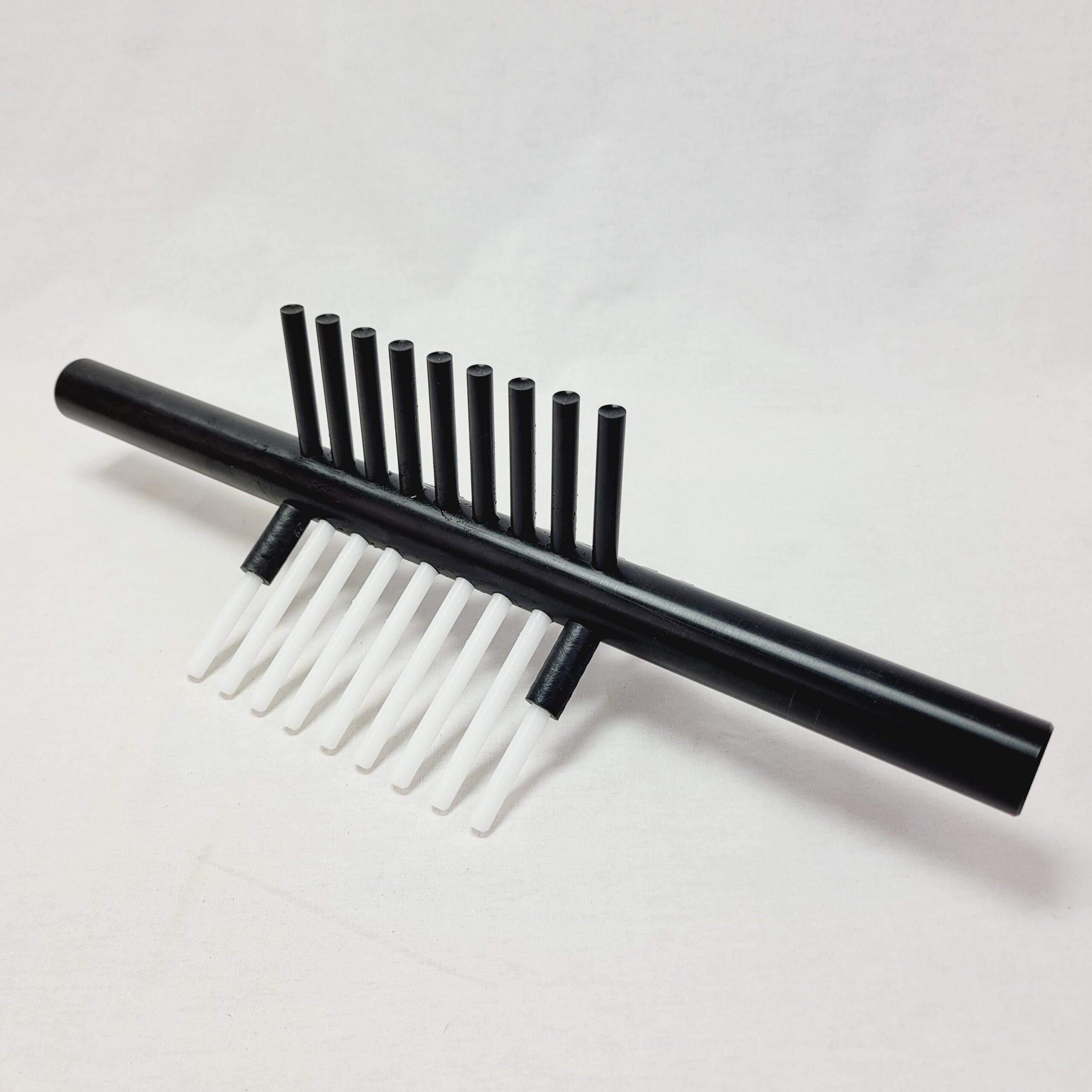
Up to 121 pre-rolls can be filled, packed and Dutch Crown-closed in under 10 minutes with one operator.
How does an automated pre-roll machine work?
An automated machine moves each cone through a row of stations with no hands on it. The person tending it keeps it supplied with cones and ground material.
Custom Cones USA's guide lists the stations an automated filling machine can have: separating cones from the stack, sensing damaged cones, filling, tamping, twisting, weighing and rejecting. Grinding, infusing, packaging and labeling can each be automated as separate machines in the same line.
That takes the operator's hands out of the cycle. It matters most in three places.
Weighing every pre-roll
The Fill N' Fold meters by volume, so every cone gets the same volume of material. It does not weigh each cone. Some automated machines weigh every pre-roll on a load cell and reject the ones out of range. If you need a recorded weight on every unit, ask how each machine records it.
Running without hands on the cones
A tray system needs its operator at the bench for the whole batch. An automated machine keeps cycling while the person tending it loads material and cones.
Steps after the close
A tray system ends at a finished, closed pre-roll. It does not pack, label or box. Some automated lines connect to packaging equipment.
The trade is price, changeover and risk. Automated machines cost many times more. The Custom Cones USA guide also warns about expensive repairs and about depending on a single machine: when it stops, the whole line stops.
How do the two compare side by side?
A tray system wins on price, size changes and low risk. An automated machine wins on hands-off running and per-unit weighing. The table sets out the rest.
| Tray system (Fill N' Fold) | Automated machine | |
|---|---|---|
| Who moves the cones | One operator, 121 cones at a time | The machine |
| Price | From $1,850 to $6,700 for a complete system | $200,000 to $400,000 and up, per Custom Cones USA |
| Published output per hour | Up to 500 to 800 with one tray. 2,500+ with three trays. | 1,000 to 3,000, per Custom Cones USA |
| Close | Dutch Crown is standard, 11 pre-rolls per press | A twist station, with a Dutch Crown station on only some machines, per Custom Cones USA |
| Fill control | By volume, all 121 cones in one pass | By weight on machines with a weigh station |
| Changing cone size | Swap the work tray, and the press tool between some sizes | New tooling and setup. Ask the maker how long it takes. |
| Material | Ground and sifted flower | Finer, drier and more consistent material, per Custom Cones USA |
| Packaging | Not included | Available on some lines |
| If it stops | A second tray set costs a few thousand dollars | The line waits for the repair |
| Fits best when | You are starting a line, run several sizes or strains, or make tens of thousands a month | Volume is high and steady in 1 or 2 SKUs |
How many pre-rolls an hour does each one make?
Published rates put a tray system at several hundred to more than 2,000 pre-rolls an hour, and an automated machine at 1,000 to 3,000. The gap in output is much smaller than the gap in price.
For the tray side there is a timed test. Custom Cones USA ran three full cycles on 84mm cones, with closing included in the time. With one operator, the Fill N' Fold averaged 837 pre-rolls an hour with a Dutch Crown finish. With a second operator and spare parts it averaged 1,361. Custom Cones USA's timed test of three cone filling machines calls the results directional, because output varies with operator experience and each facility's setup.
For the automated side, a Custom Cones USA article on when to automate pre-roll production says automated machines make 1,000 to 3,000 pre-rolls an hour. Makers publish their own rates. Ask for a tested rate on your cone size and your material.
Hourly rates hide the question that matters: how many hours a month does the machine need to run to hit your number? The next table answers that. A full-time month is about 173 hours.
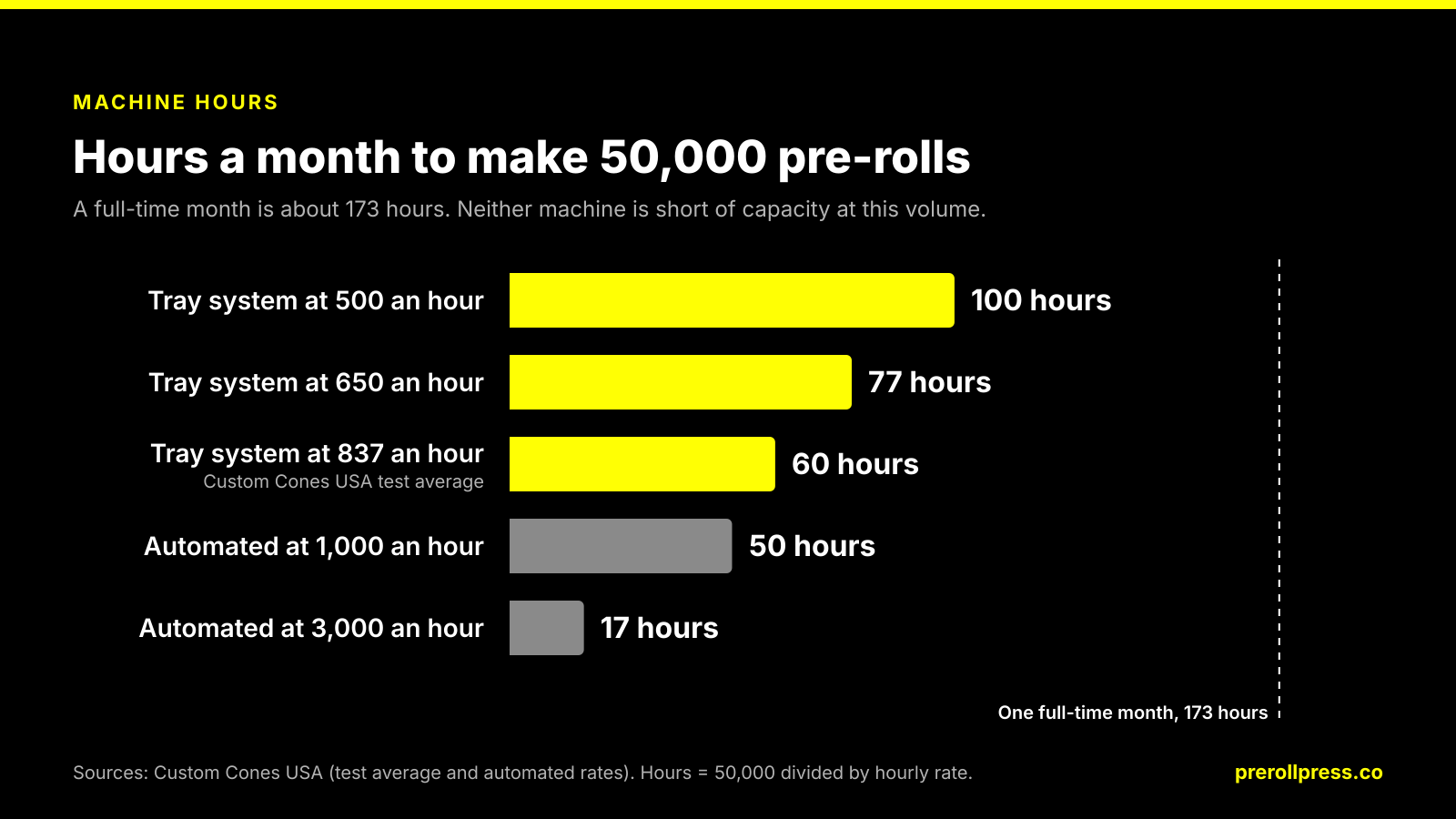
| Monthly volume | Tray at 500 an hour | Tray at 650 an hour | Tray at 837 an hour (test average) | Automated at 1,000 an hour | Automated at 3,000 an hour |
|---|---|---|---|---|---|
| 50,000 | 100.0 hours | 76.9 hours | 59.7 hours | 50.0 hours | 16.7 hours |
| 150,000 | 300.0 hours | 230.8 hours | 179.2 hours | 150.0 hours | 50.0 hours |
| 500,000 | 1,000.0 hours | 769.2 hours | 597.4 hours | 500.0 hours | 166.7 hours |
Read the 50,000 row. At published rates, an automated machine makes a month of product in 17 to 50 hours and then sits. One operator on one tray system needs 60 to 100 hours. At that volume you are not short of capacity on either machine, so the choice comes down to cost.
What does each one cost per pre-roll?
At 50,000 pre-rolls a month, a tray system costs far less per pre-roll than an automated machine. The price gap is too large for fill-and-close labor savings to cover.
Use one formula for any machine, so you compare like with like.
Cost per pre-roll = (machine price + setup + service + labor + downtime losses) divided by the sellable pre-rolls made over the same period.
Here is the arithmetic for the two parts you can know before you buy, the machine and the fill-and-close labor. Change any line to your own numbers.
Worked example
Assumptions: 50,000 pre-rolls a month. One operator at 837 pre-rolls an hour, the Custom Cones USA single-operator test average. A wage of $20.78 an hour, the U.S. median for packaging and filling machine operators in Bureau of Labor Statistics 2025 wage data reported by O*NET. Wage only, with no payroll tax, benefits or supervision.
| Tray system | Automated machine | |
|---|---|---|
| Machine price | Single Tray System with Metering Tray, $2,500 | $250,000, inside the published $200,000 to $400,000+ range |
| Machine cost per pre-roll over the first 12 months (600,000 pre-rolls) | $0.004 | $0.417 |
| Fill-and-close labor hours a month | 59.7 (50,000 divided by 837) | Not published. Ask the maker. |
| Fill-and-close labor cost a month | $1,241 (59.7 hours at $20.78) | Not published. Ask the maker. |
| Labor cost per pre-roll | $0.025 | Not published. Ask the maker. |
Result: machine and labor on the tray system come to about 3 cents a pre-roll in year one. The automated machine starts at about 42 cents a pre-roll before any labor, power or service.
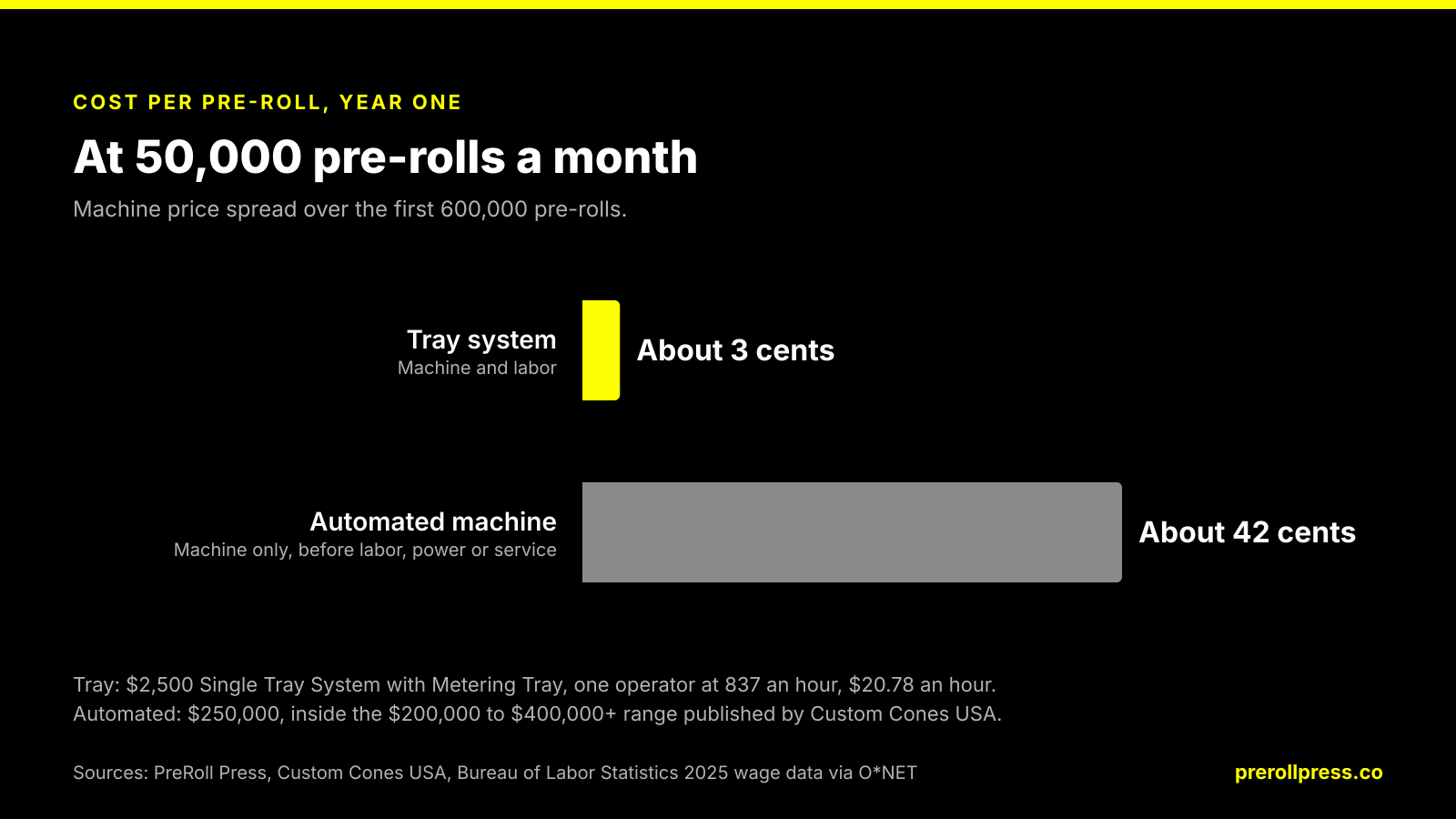
Spread the automated machine over 5 years instead of 1 and its machine cost falls to about 8 cents a pre-roll at this volume. That is still more than the tray system's machine and labor together.
At what volume does an automated machine pay for itself?
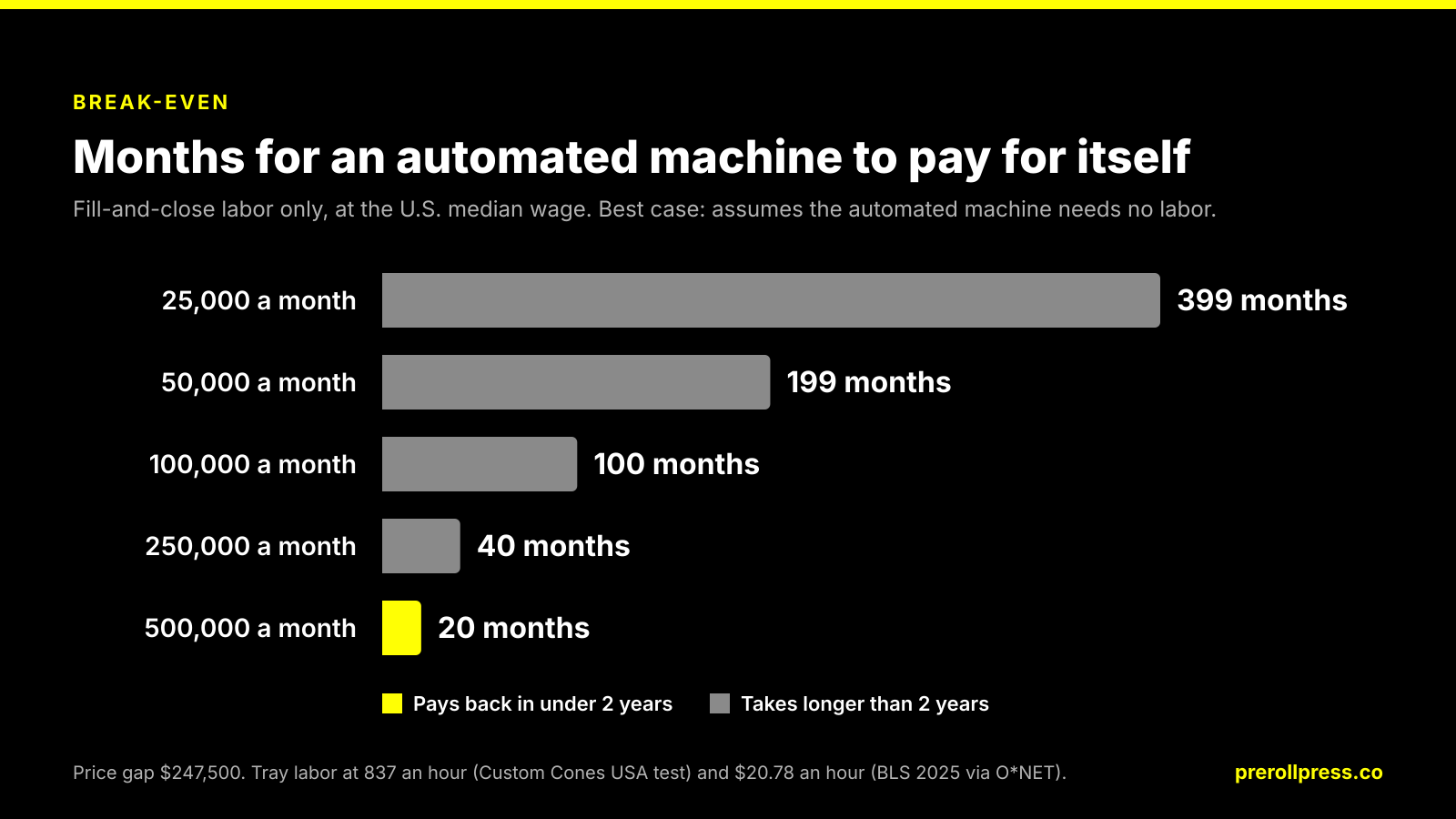
On fill-and-close labor alone, an automated machine pays for itself in under 2 years only at several hundred thousand pre-rolls a month. Below that, the labor it can remove is too small.
The price gap in the worked example is $247,500. The table shows how many months of tray-system labor it takes to equal that gap. It assumes the automated machine needs no labor at all, which is the best case for automation. It will need some, so real payback takes longer.
| Monthly volume | Tray labor hours a month | Months to pay back at $16.06 an hour (10th percentile) | Months to pay back at $20.78 an hour (median) | Months to pay back at $28.86 an hour (90th percentile) |
|---|---|---|---|---|
| 25,000 | 29.9 | 516 | 399 | 287 |
| 50,000 | 59.7 | 258 | 199 | 144 |
| 100,000 | 119.5 | 129 | 100 | 72 |
| 250,000 | 298.7 | 52 | 40 | 29 |
| 500,000 | 597.4 | 26 | 20 | 14 |
The three wages are the 10th percentile, median and 90th percentile for packaging and filling machine operators in the same Bureau of Labor Statistics data. The formula is simple: months to pay back = price gap divided by (monthly volume divided by 837, times your hourly wage).
Three cautions on these numbers
The 837 an hour figure came from a short test. A full shift will average lower. At 600 an hour, labor hours rise by about 40% and payback falls by about 28%.
At 250,000 a month and above you would run more than one tray and more than one operator. That narrows the price gap by a few thousand dollars.
Wage is not the full cost of a person. Add payroll tax and benefits at your own rate and payback shortens again.
Why other guides say 50,000 a month
Custom Cones USA's guide puts the turning point near 50,000 a month, and its chief executive has put the move from tabletop to automated machines at 50,000 to 100,000 a month. Neither figure comes with a calculation. On fill-and-close labor alone, the table above puts the turning point much higher.
The difference is everything else an automated line can replace: weighing, quality checks and packaging labor. If those steps take more of your labor than filling and closing, add them to the savings column and run the table again. The method matters more than any single threshold.
What costs does a machine quote leave out?
A quote covers the machine. It rarely covers what it takes to keep the machine running. Ask every seller, including us, for each line below in writing.
| Cost | What to ask |
|---|---|
| Tooling for each cone size | Is every size I run included, and what does each extra size cost? |
| Shipping and setup | Who installs it, how long does it take, and what does it cost? |
| Power, air and room conditions | What supply does it need, and does the room need climate control? |
| Training | How long until my team runs it alone, and is training included? |
| Service | What does a service plan cost, and how fast does a technician arrive? |
| Spare parts | Which parts wear, what do they cost, and are they in stock? |
| Downtime | What do I run while the machine is being repaired? |
| Operator turnover | How long does it take to train a replacement operator? |
| Cones | Does the machine need a specific cone, and from which suppliers? |
| Financing | What is the total paid over the term, with interest? |
For a Fill N' Fold system, the answers are short. Ground shipping is free in the continental US. On-site production training is included. The warranty is lifetime on parts and motors, with one-year replacement on electronics. Most items are in stock and ship the next day.
Custom Cones USA's guide adds one more cost that no quote shows: staff turnover. An automated machine needs trained operators, and each one who leaves takes that training out the door.
How do cone sizes and strain changes affect the choice?
The more sizes and strains you run, the more a tray system makes sense. Every change on an automated machine costs setup time, and that time produces nothing.
Custom Cones USA's guide gives a rule of thumb. Automated machines suit a line that runs 1 to 2 SKUs a day. A line that runs 3 to 5 sizes and several strains a week points toward a tabletop machine.
On a tray system, a strain change is a cleanup between batches. A size change means swapping the work tray and, between some sizes, the press tool. The large press tool fits 109mm and 98mm trays, and the small one fits 84mm and 70mm.
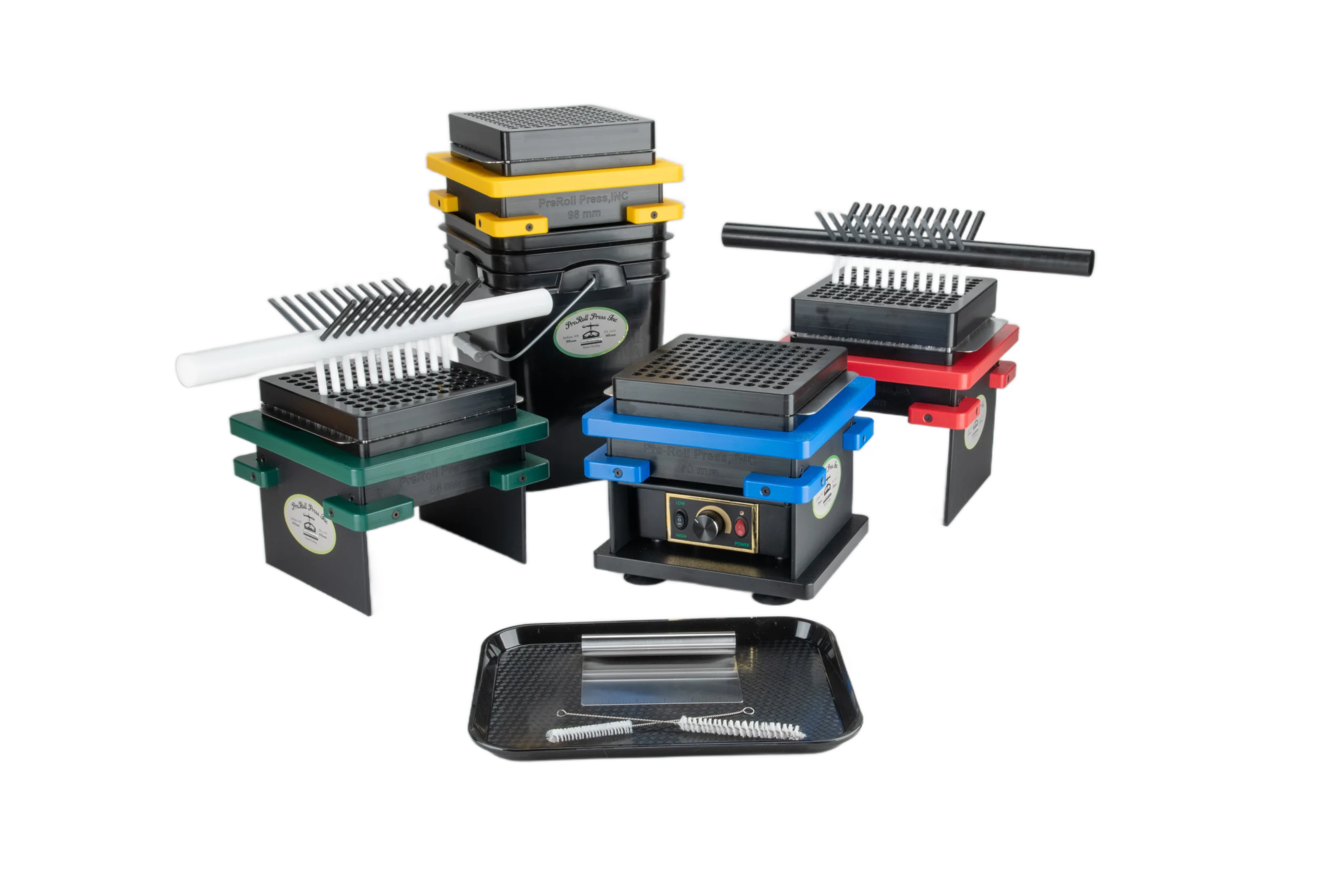
Fill N' Fold All-In System · $6,700
Work trays and metering trays for 109mm, 98mm, 84mm and 70mm cones, with both press tools, so a size change is a tray swap.
What material prep does each one need?
Both need ground, consistent material. An automated machine is stricter about it, because nobody is watching each cone.
Custom Cones USA's guide says automated machines need material that is finer, drier and consistent in particle size, and names bud density and moisture as critical. It also recommends a cool, humidity-controlled room. Ask each maker for its grind and moisture targets in writing.
A tray system is more forgiving, because the operator sees every batch. Sifting still pays. In the Custom Cones USA test, the flower was ground and sifted before filling so the particle size was uniform. We sell the Flora Mill Fine 14 mesh sifter and grinder for that step, along with other sifting and cleanup accessories.
Can you automate part of a tray system?
Yes. You can take hand work out of the two slowest steps, loading cones and closing, without replacing the system.
Loading cones
Placing 121 cones by hand is the first slow step. The Fill N' Fold Pre-Roll Cone Dispenser holds 121 stacks of cones and loads a full tray in one drop.
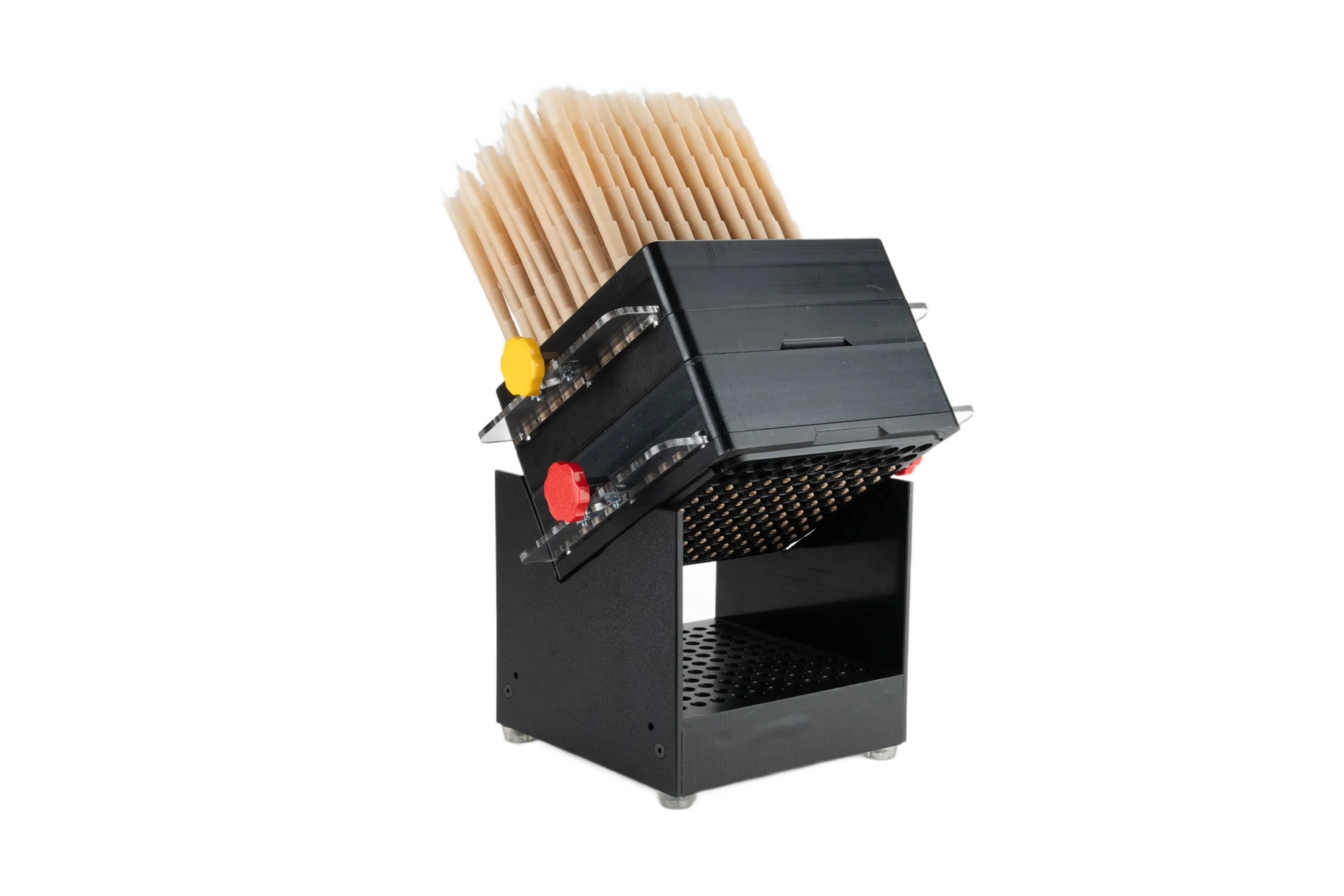
Fill N' Fold Pre-Roll Cone Dispenser · $1,950
Loads all 121 cones into a work tray in one drop, so the operator stops placing cones one by one.
Closing
The Pneumatic Press closes, tamps and ejects an entire work tray at once. The product page says it cuts closing time by as much as 50%. We have not published an hourly figure for it, so ask us for a demonstration on your cone size.
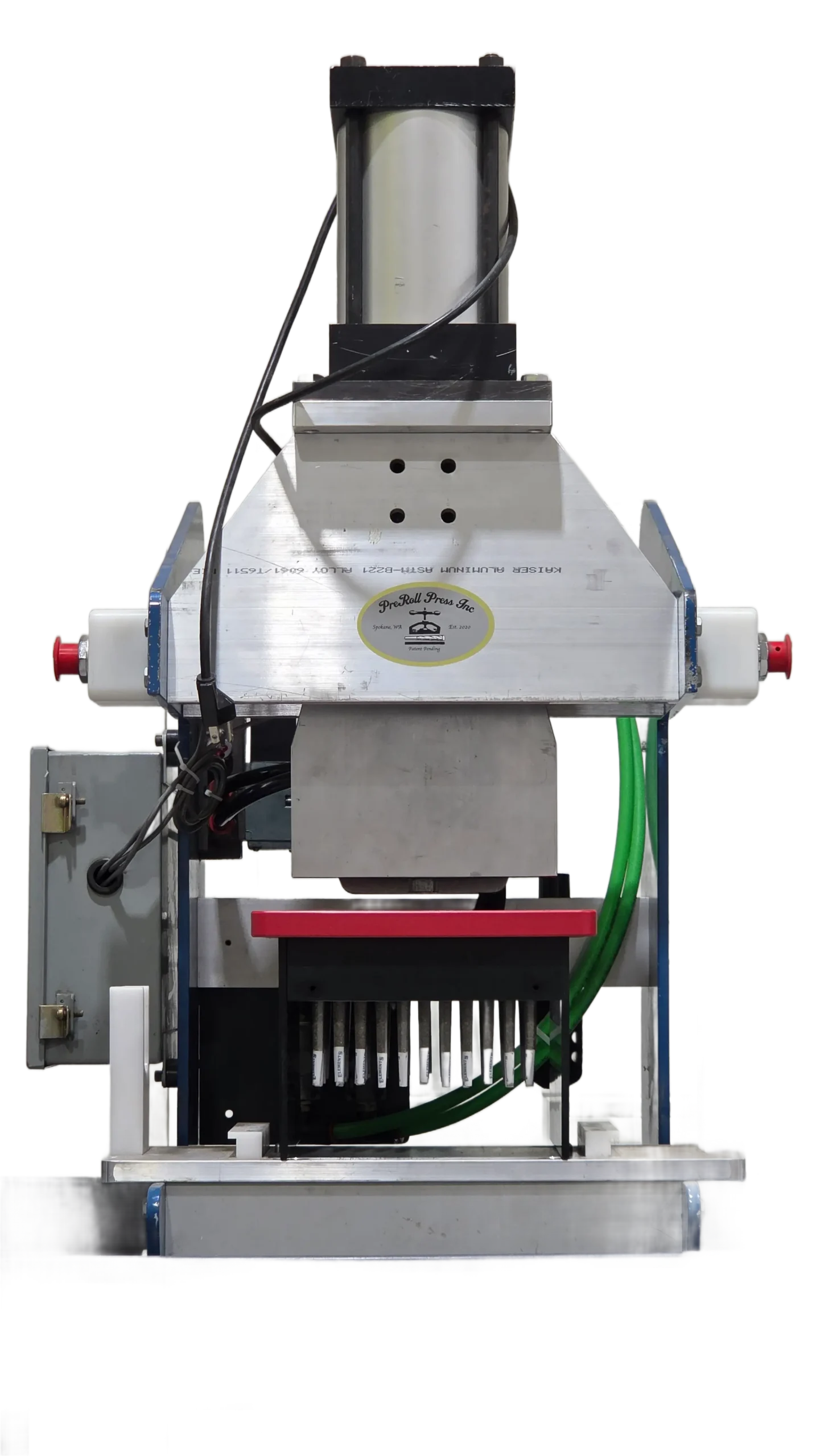
Pneumatic Press · $15,000
Closes, tamps and ejects a full work tray in one cycle for lines where closing is the bottleneck. Available by inquiry.
Both keep the same trays, the same Dutch Crown and the same bench. For many lines, that is the step between a tray system and a six-figure machine. The full list is on our Fill N' Fold add-ons page.
When is a tray system the wrong choice?
A tray system is the wrong choice when you need something it does not do. There are four cases.
| If you need | Why a tray system falls short |
|---|---|
| A recorded weight on every pre-roll | It meters by volume and does not weigh each cone. |
| A line that runs with nobody at the bench | An operator works every batch from loading to ejecting. |
| Packaging, labeling or boxing in the same machine | It ends at a closed pre-roll. |
| Several hundred thousand pre-rolls a month of one SKU | You would need several trays and operators, and the labor math starts to favor automation. |
If one of these describes your line, get tested rates from automated machine makers and run the break-even table with your own numbers.
Which one fits your volume?
Start with your monthly target and the number of cone sizes you run. Under a few thousand pre-rolls a day, one tray is usually enough.
| Your line | Likely fit |
|---|---|
| Starting out, or under a few thousand pre-rolls a day in one size | A single tray system |
| Growing volume in one or two sizes | A double or triple tray system |
| Every cone size, or frequent size changes | The All-In System |
| Closing is the bottleneck on a tray system | Add the Pneumatic Press |
| Loading cones is the bottleneck | Add the Cone Dispenser |
| Several hundred thousand a month of one SKU, with per-unit weighing and inline packaging | An automated line. Get tested rates on your material first. |
These are the Fill N' Fold systems with a metering tray, with the "up to" output figures from our machines page.
| System | Price | Stated output per hour |
|---|---|---|
| Single Tray System with Metering Tray | $2,500 | Up to 500 to 800 |
| Double Tray System with Metering Tray | $4,350 | Up to 1,000 to 2,000 |
| Triple Tray System with Metering Tray | $5,600 | 2,500+ |
| Fill N' Fold All-In System | $6,700 | 2,500+ |
Single Tray System with Metering Tray · $2,500
One 121-cone work tray with the metering tray that fills every cone to the same volume. This is where most new lines start.
See all Fill N' Fold pre-roll machines, or read how to choose the right Fill N' Fold system for your operation.
What should you ask before buying an automated machine?
Ask for tested numbers on your own material, not headline rates. These questions cover most of what goes wrong after the purchase.
| Question | Why it matters |
|---|---|
| What is the tested output per hour on my cone size, and with how many people? | A headline rate and a floor rate are rarely the same number. |
| Can I run my own material on it before I buy? | Rates change with grind, moisture and strain. |
| What does a cone size change involve, and how long does it take? | Lines with many SKUs lose their time here. |
| What grind size and moisture does the machine need? | Your material prep may have to change. |
| Is closing included, and what finish does it give? | On some machines closing is a separate device or step. |
| Does it weigh every pre-roll, and what happens to rejects? | Rejected pre-rolls are material and labor you pay for twice. |
| How many pre-rolls has this model made in the field? | A first design and a fifth design are different risks. |
| Can I talk to two operators who run it today? | They will tell you what the brochure does not. |
| What does service cost, and how fast does it arrive? | A stopped line makes nothing. |
| What is the full installed price? | The quoted price may not include tooling, air supply or training. |
If you are still comparing tabletop and tray machines, start with our cone filling machine guide for commercial pre-roll production.
What do the terms mean?
These are the terms sellers use, in plain words.
| Term | Meaning |
|---|---|
| Automated pre-roll machine | A machine that loads, fills and closes cones with a person tending it, not moving the cones. |
| Tray system | A machine where one operator moves a tray of cones through filling, packing and closing as one batch. |
| Semi-automatic | A seller's word for any machine that does some steps while a person does the rest. Tray systems are often sold under this name. |
| Work tray | The tray that holds the cones. On the Fill N' Fold it holds 121 cones of one size. |
| Metering tray | The tray that drops the same volume of material into every cone in one pass. |
| Packing base | The base that settles the material in every cone to the same density. |
| Press tool | The tool that folds, tamps and crowns 11 pre-rolls per press. |
| Dutch Crown | A folded, tamped top on a pre-roll, used in place of a twist. |
| Changeover | The work of switching a machine from one cone size or strain to the next. |
| Pack density | How tightly the material sits in the cone. |
| Payback | The time it takes for savings to equal the price of the machine. |
| SKU | One product you sell: one size of one strain in one pack. |
Frequently asked questions
What is an automated pre-roll machine?
An automated pre-roll machine loads, fills and closes cones with little hand work. A person tends the machine instead of moving each cone. Custom Cones USA puts fully automated machines at $200,000 to $400,000 and up. Some also weigh every pre-roll and reject the ones out of range. Ask each maker for a tested hourly rate on your cone size.
Is a tray system a manual or an automated pre-roll machine?
A tray system sits between the two, and many sellers call it semi-automatic. One operator moves a tray of cones through filling, packing and closing, so it is not automated. But nothing is done one cone at a time, so it is far from hand filling. On the Fill N' Fold, one tray holds 121 cones and one press closes 11 pre-rolls.
How many pre-rolls per hour can one operator make on a tray system?
In a Custom Cones USA test on 84mm cones, one operator averaged 837 pre-rolls an hour on a Fill N' Fold, with a Dutch Crown finish. Two operators with spare parts averaged 1,361. Custom Cones USA calls the results directional. Your rate will depend on operator experience, material and cone size.
How much does an automated pre-roll machine cost?
Custom Cones USA's guide to automated machines puts a fully automated pre-roll machine at $200,000 to $400,000 and up. That is the machine alone. Ask each seller for the installed price, including tooling for every cone size, shipping, setup, training and a service plan, before you compare it with any other option.
When does an automated pre-roll machine make financial sense?
It makes sense when the labor it removes can pay for the machine. Custom Cones USA puts that point at about 50,000 pre-rolls a month. On fill-and-close labor alone, our math puts it at several hundred thousand a month. Count weighing, quality checks and packaging labor too, then run the numbers with your own wage and output.
Does a tray system weigh each pre-roll?
No. The Fill N' Fold meters by volume, so the metering tray fills all 121 cones to the same volume in one pass. It does not weigh each cone. If you need a recorded weight on every pre-roll, weigh a sample from each tray on a scale, or look at an automated machine with a built-in weigh station.
Can I add automation to a Fill N' Fold later?
Yes. The Pneumatic Press closes, tamps and ejects a full work tray at once, and the Cone Dispenser loads a full tray of 121 cones in one drop. Both are add-ons to a Fill N' Fold system. You keep the same Dutch Crown finish and take hand work out of the two slowest steps, loading and closing.
Are there automatic joint rolling machines?
Yes, and there are two kinds. Most automated machines fill pre-rolled cones: they load a cone, fill it, pack it and close it. A smaller group rolls a joint from flat paper instead of filling a cone. A tray system is different from both: it fills pre-rolled cones in batches, with one operator moving the tray.
What grind does an automated pre-roll machine need?
Custom Cones USA's guide says automated machines need material that is finer, drier and consistent in particle size, and that bud density and moisture matter. Each maker sets its own target. Ask for the exact grind size and moisture range in writing, then check that your current prep can hit it before you buy.
Which is better for a line with many cone sizes and strains?
A tray system usually fits better. Custom Cones USA's guide says automated machines suit lines that run 1 to 2 SKUs a day, and that 3 to 5 sizes with several strains a week point toward a tabletop machine. On a Fill N' Fold, a size change means swapping the work tray and sometimes the press tool.
Tell us how many pre-rolls you need and which sizes, and we will recommend a system. Call 509-701-0035.