 Skip to content

Choosing a pre-roll machine isn’t just about how many cones it can hold or how fast it can fill them. What matters is how well the equipment fits into your production process.
A facility producing one cone size a few days a week has different needs from an operation running several products across multiple shifts. Some producers prefer to meter their material before filling, while others already have a system for measuring and distributing flower. These differences matter when selecting equipment.
That’s why Fill N Fold comes in several configurations.
From Single, Double, and Triple Tray systems to the multi-size All-In package, each option is built around the same approach to filling, packing, and Dutch Crown finishing. The differences lie in the number of work trays, metering equipment, and components included.
This guide will help you understand those differences, assess your production needs, and choose the setup that makes the most sense for your facility.
Table of Contents
Start with Your Production Needs, Not the Machine
Before comparing Fill N Fold systems, take a closer look at how your production floor operates.
There are five questions worth answering.
1. How many pre-rolls do you need to produce?
Think about your average production day, not just the busiest day you’ve ever had. Are you producing a few hundred pre-rolls for smaller batches, or do you have recurring orders that require several thousand finished units?
Your production target helps determine how many work trays you may want in rotation.
2. How many cone sizes are you working with?
If most of your products use the same cone size, you may not need equipment for every size available.
On the other hand, if your brand sells different pre-roll formats, you’ll need the appropriate work trays and press tools for those products.
3. How do you measure and distribute your material?
Some operations prefer to portion material directly using a metering tray. Others already have a manual or separate preparation process.
Understanding this part of your workflow helps determine whether a system with metering is the better choice.
4. How many people will operate the equipment?
A single operator working through every step has different workflow requirements from a team where employees can prepare, pack, and finish trays at separate stations.
More work trays may help keep different stages of production moving, but the benefit depends on how the team is organized.
5. Are your production requirements likely to change?
You may only produce one cone size today but plan to introduce new SKUs in the future. Or you may expect daily production volume to increase over the coming months.
It’s worth considering those plans before deciding which equipment to purchase.
Understanding the Fill N Fold System
If you’re still exploring the equipment, take a look at our Fill N Fold commercial pre-roll machines to see the available systems, configurations, and pricing before comparing them in detail.
Every standard Fill N Fold configuration is built around a tray-based production process.
Each work tray holds up to 121 pre-rolled cones. Operators use the system’s components to prepare, fill, pack, and finish the cones in batches rather than completing every production step individually for each pre-roll.
The press tool is an important part of that workflow. It helps operators crimp, tamp, and finish cone tops with a Dutch Crown closure.
The standard Fill N Fold systems are operator-controlled mechanical equipment, not fully automated production lines. Their purpose is to make manual production more organized and efficient while keeping operators involved in the process.
The major differences between configurations are straightforward:
- Single Tray: One work tray for a simpler batch workflow.
- Double Tray: Two work trays that allow more flexibility in organizing production.
- Triple Tray: Three work trays for facilities that want additional trays in rotation.
- All-In: Four size-specific work trays and corresponding metering equipment covering the four standard cone sizes.
Single, Double, and Triple Tray configurations are also available with or without metering trays.
Let’s look at how those choices affect your operation.
Single, Double, Triple, or All-In: What’s the Difference?
Single Tray System — A Practical Starting Point
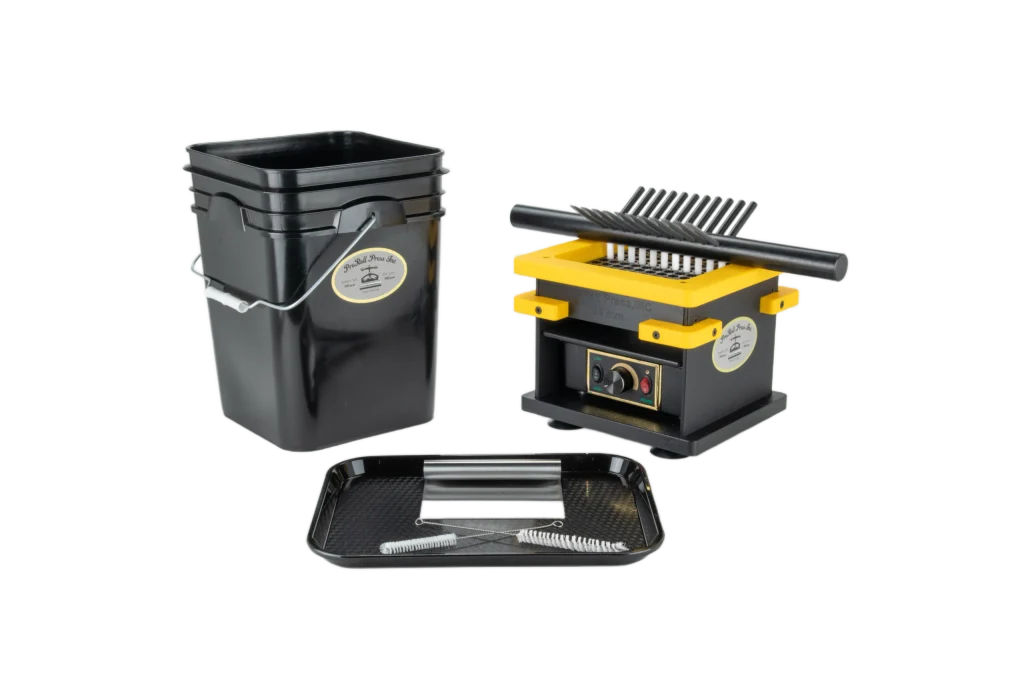
Not every production facility needs several trays operating at once.
If you’re producing smaller batches, primarily working with one cone size, or introducing a more structured process to your facility, the Single Tray System may be all you need.
It provides one 121-cone work tray, a corresponding press tool, a packing base, and the supporting accessories needed for its configuration.
The process is straightforward: prepare a batch, complete the filling and finishing stages, and get the tray ready for the next cycle.
Because you’re working with one work tray, you generally need to finish the current tray’s workflow before using it for the next batch.
A Single Tray System may make sense when:
- You’re starting or upgrading a small pre-roll operation.
- You mainly produce one cone size.
- One operator handles most stages of production.
- You want a complete filling and finishing system without purchasing additional work trays immediately.
You can choose the Single Tray System without metering or with metering, depending on how you plan to distribute material.
Double Tray System — More Flexibility Between Production Stages

As production increases, the way you organize work becomes increasingly important.
Consider a facility where one operator is preparing cones while another is packing or finishing a batch. With only one work tray, some of those activities may need to happen sequentially.
A second work tray gives your team another place to prepare or hold a batch while work continues elsewhere.
That flexibility can help reduce unnecessary interruptions, particularly when the facility has enough staff and workspace to support overlapping tasks.
The Double Tray System includes two work trays, two press tools, one packing base, and supporting accessories. The metering version also includes two corresponding metering trays.
A Double Tray System may make sense when:
- Your facility runs pre-roll production regularly.
- You want two work trays available during a production run.
- Your employees share responsibility for different stages.
- You frequently prepare another batch while the first is being processed.
- You’re looking for more workflow flexibility without moving to a three-tray setup.
The key benefit isn’t that two trays automatically double production. It’s that operators have more flexibility to organize the work.
Explore the Double Tray System without metering or the Double Tray System with metering.
Triple Tray System — For Production Floors That Need More Trays in Rotation

When pre-roll production becomes a major part of your daily operation, keeping work moving between stages becomes especially important.
A Triple Tray System provides three work trays, giving teams more flexibility to organize preparation, packing, and finishing activities.
For example, one tray might be undergoing preparation while another is being packed and a third is being finished. Whether these tasks can overlap effectively depends on your staffing, workspace, and available equipment.
This approach can be useful for facilities running repeated batches throughout the day or managing multiple operators.
The Triple Tray System includes three work trays, two press tools, a packing base, and supporting accessories. The metering configuration includes three corresponding metering trays.
A Triple Tray System may make sense when:
- Pre-roll production runs for extended periods.
- Multiple operators work across different stages.
- Your existing setup experiences delays while trays are being prepared.
- You want additional work trays available for batch rotation.
- Production requirements justify the added equipment and workspace.
More trays create more workflow options. The actual improvement in output will depend on how efficiently those trays are used.
Compare the Triple Tray System without metering and the Triple Tray System with metering.
All-In System — When Your Product Line Includes Multiple Cone Sizes

The All-In System serves a slightly different purpose.
While Single, Double, and Triple Tray systems are primarily differentiated by their number of work trays, the All-In package is designed to provide equipment for all four standard cone sizes.
It includes:
- Four work trays: 70mm, 84mm, 98mm, and 109mm.
- Four corresponding metering trays.
- Two press tools covering the standard size groups.
- One packing base.
- Two buckets with lids, two catch trays, two scrapers, and two tube brushes.
This can be particularly valuable for producers offering several pre-roll formats or planning to expand their product range.
Instead of assembling individual size-specific components over time, the All-In System provides a broader set of equipment in one package.
The All-In System may make sense when:
- Your brand produces several cone sizes.
- Your product lineup includes different pre-roll formats.
- You frequently change between cone sizes.
- You want the standard size-specific trays and metering equipment available from the beginning.
- You’re planning to expand into additional cone sizes.
One important distinction: the All-In System is not necessarily the fastest choice simply because it includes four trays. Its main advantage is the range of cone sizes and components supplied.
If your facility produces only one cone size, a Double or Triple Tray configuration may be more appropriate, depending on how you organize production.
Explore the Fill N Fold All-In System.
Should You Choose a System With or Without Metering?
This is one of the most important decisions when selecting a Fill N Fold configuration.
A metering tray helps operators portion and distribute material before it enters the pre-rolled cones. It’s intended to make that preparation stage more organized and repeatable.
When a Metering Tray Makes Sense
A system with metering may be a better fit if your operation wants a dedicated method of distributing material across a batch before filling.
It can be especially useful when multiple operators are following the same production process and you want a consistent approach to material preparation.
However, a metering tray does not eliminate the need to calibrate your process and check finished product weights. Material properties, preparation, and operator technique still matter.
When a System Without Metering Makes Sense
Some facilities already have a preferred way of preparing or measuring material.
If your operation manually portions flower or uses another suitable preparation method, you may prefer a system without included metering trays.
These configurations still provide the relevant work trays, press tools, and packing equipment for the system. They simply exclude the metering-tray components.
The right decision depends on how your team currently works and whether introducing metering would improve that process.
For a closer look at the component, explore the Fill N Fold Adjustable Metering Tray.
Choosing the Right Cone Sizes
Before ordering any Fill N Fold system, confirm which pre-rolled cones your facility intends to use.
The four standard sizes are:
| Cone size | Common production application |
| 70mm | Shorter pre-rolls, often called dog walkers |
| 84mm | Compact pre-roll formats |
| 98mm | Mid-size pre-roll formats |
| 109mm | Longer, commonly used 1-gram formats |
These are cone-length categories, not guarantees of the finished weight. Actual fill weight depends on the paper, filter, material, and packing process.
Fill N Fold uses size-specific work trays. Selecting the correct components for your chosen papers is essential.
The press tools also come in two standard size groups:
- Large press tool: 98mm and 109mm work trays.
- Small press tool: 70mm and 84mm work trays.
For Single, Double, and Triple Tray systems, check which sizes you’re selecting and confirm that the supplied press tools cover your intended combination.
If you only produce 109mm pre-rolls, there may be little reason to purchase components for the other three standard sizes immediately.
But if your brand sells all four formats, the All-In System may offer a more convenient way to equip your production floor.
How Many Work Trays Does Your Facility Actually Need?
It’s easy to assume that more trays automatically mean faster production.
In practice, the relationship is more complicated.
Consider the complete workflow: loading papers, preparing material, filling, packing, crimping, tamping, ejecting, inspecting, and getting ready for the next batch.
With one work tray, the operator completes the required stages and then prepares that tray for the next cycle.
With two or three work trays, your team has additional trays available for preparation or processing. This may allow certain tasks to overlap and reduce interruptions.
But if one operator is responsible for every stage, adding more trays will not necessarily multiply hourly output.
The benefit depends on the actual bottleneck.
For example:
If cone loading takes too long: An additional work tray or compatible loading accessory may help organize preparation.
If material distribution is slowing down production: A metering tray may be worth considering.
If packing or finishing is the limiting stage: Review how those tasks are assigned, the tools being used, and whether multiple operators can work effectively.
If you’re frequently changing cone sizes: Having the appropriate size-specific components ready may matter more than maximizing the number of trays assigned to one size.
Before investing, identify which part of your existing process creates the longest delays.
That will tell you more about the right equipment than an advertised hourly production number alone.
Compare the Fill N Fold System Configurations
Here’s a breakdown of the seven standard system packages.
| System | Work trays | Metering trays | Press tools | Listed price |
|---|---|---|---|---|
| Single without Metering | 1 | 0 | 1 | $1,850 |
| Single with Metering | 1 | 1 | 1 | $2,500 |
| Double without Metering | 2 | 0 | 2 | $3,100 |
| Double with Metering | 2 | 2 | 2 | $4,350 |
| Triple without Metering | 3 | 0 | 2 | $3,850 |
| Triple with Metering | 3 | 3 | 2 | $5,600 |
| All-In System | 4 | 4 | 2 | $6,700 |
Prices are in USD and reflect the published product listings as checked in November 2026. Prices, availability, shipping, and package contents should be reconfirmed before ordering.
All configurations also include a packing base and specified supporting accessories. Accessory quantities vary by package.
How to Read This Comparison
Don’t select a system solely by looking at the price or total number of trays.
Start by deciding how many work trays your operation needs, whether you want metering included, and which cone sizes you’re producing.
Then compare the packages that meet those requirements.
If you’re deciding between two configurations, consider how often your team would use the additional components and whether they would address a real production bottleneck.
Three Realistic Production Scenarios
The following examples illustrate how to approach the decision. They are not guaranteed equipment recommendations for every facility.
Scenario 1: A Small Brand Producing One Cone Size
A producer primarily manufactures one standard pre-roll SKU and handles production in relatively small batches.
One or two employees prepare the material, fill cones, and finish the products. Their priority is moving away from individually handling every pre-roll throughout the entire process.
Where to start: The Single Tray System.
If the business wants a dedicated way to meter material before filling, the Single Tray with Metering is worth considering. Otherwise, the without-metering option may suit its existing preparation workflow.
The business can evaluate additional trays if production demand grows.
Scenario 2: A Growing Facility Producing Pre-Rolls Every Day
A facility has recurring production targets and employees assigned to different tasks.
The team wants to prepare batches while other work is underway, rather than relying on one tray moving through every stage before preparation can begin again.
Where to start: Compare the Double and Triple Tray Systems.
The decision depends on staffing, how workstations are organized, and whether two or three trays would meaningfully reduce interruptions.
The metering option should be considered separately based on material preparation needs.
Scenario 3: An Established Producer Offering Multiple Cone Sizes
A manufacturer offers several pre-roll formats and regularly produces different SKUs.
The production team needs size-specific components and wants to reduce the inconvenience of assembling a different equipment setup every time the product changes.
Where to start: Compare the All-In System against a custom selection of Single, Double, or Triple Tray components.
The All-In package is particularly relevant if the facility needs all four standard sizes.
However, if it only produces two sizes, a tailored Double or Triple Tray configuration may be sufficient. The right choice depends on both cone-size coverage and the number of trays required for production.
What About Additional Accessories?
Not every facility needs every available accessory on day one.
One advantage of the Fill N Fold product range is that several components can be purchased separately.
For example, the Fill N Fold Pre-Roll Cone Dispenser is designed to assist with loading cones into the production setup. It may be worth considering for operations where paper loading takes a significant amount of time.
Additional work trays, press tools, and other compatible equipment are also available separately.
Before buying accessories, establish which components are already included in your chosen package.
Then decide whether extra equipment would solve a particular problem in your workflow.
You can explore the available options on our pre-roll machine add-ons page.
Don’t Judge a Machine by Filling Speed Alone
Production speed matters, but filling cones is only one part of producing a finished pre-roll.
A machine may fill a large number of cones quickly, yet the operation could still spend considerable time loading papers, preparing material, closing tips, or inspecting finished products.
This is why equipment should be evaluated on its complete production workflow.
When comparing systems, consider:
- How many acceptable, finished pre-rolls your team produces during a normal shift.
- How many operators are involved in that output.
- How much time is spent preparing and loading materials.
- How long packing and finishing take.
- How frequently equipment needs cleaning, adjustment, or a change of cone size.
- Whether finished units consistently meet your quality and weight requirements.
Where possible, assess the system with your own papers, materials, staffing, and production methods.
That will provide a more useful picture of its suitability than relying on a maximum hourly output figure measured under different conditions.
Before You Place Your Order
By this point, you should have a clearer picture of which Fill N Fold configuration might suit your operation.
Before making your final choice, confirm the following details:
- Your current production target and anticipated growth.
- The cone sizes you need to manufacture.
- Whether your facility wants included metering trays.
- How many work trays your team can use effectively.
- Which press-tool sizes are required.
- The components and accessories included in the package.
- Whether any additional equipment is needed for your specific workflow.
- Current pricing, shipping arrangements, and warranty coverage.
If you’re unsure about any of these details, it’s worth discussing them with the manufacturer before purchasing.
Frequently Asked Questions About Choosing a Fill N Fold System
Is the Triple Tray System always faster than the Single Tray System?
Not necessarily. The Triple Tray System provides more work trays, which may allow operators to organize production stages more efficiently. Actual output depends on staffing, material preparation, workflow, and how the trays are used.
Do I need a metering tray to use Fill N Fold?
No. Single, Double, and Triple Tray configurations are available without metering trays. You will still need a suitable method of portioning and distributing material for your production process.
Can I use different cone sizes with a Double or Triple Tray System?
The product configurations allow customers to select work-tray sizes. However, you should confirm that the included press tools and other components support the particular sizes you want to combine.
Should I buy the All-In System if I want the highest production output?
Not automatically. The All-In System is primarily designed to provide equipment for all four standard cone sizes. If your facility mainly uses one size, additional work trays for that size may be more relevant than purchasing all four sizes.
Do Fill N Fold systems require a separate Dutch Crown closing machine?
The standard Fill N Fold systems include press tools used for crimping, tamping, and Dutch Crown finishing. You should review the demonstration and included components to understand how the finishing process works.
For more information, read our guide to Dutch Crown pre-rolls.
Can I expand my setup later?
Individual work trays, press tools, metering trays, and additional components are available separately. Before expanding, confirm compatibility with your existing equipment and compare the total cost with a larger system package.
The Right System Is the One That Fits Your Production
There’s no single Fill N Fold configuration that’s automatically right for every producer.
A small facility producing one cone size may have everything it needs with a Single Tray System. A growing operation may benefit from additional trays in rotation. And a manufacturer offering several pre-roll formats may find the All-In package more practical.
The goal is to choose equipment that supports the way your team works today while leaving room for the production needs you expect tomorrow.
Ready to explore the options?
Compare All Fill N Fold Commercial Pre-Roll Machines
Or, if you’d rather discuss your setup first, contact PreRoll Press to review your cone sizes, production requirements, and equipment options before ordering.