
A used pre-roll machine can save real money on a large automated line, where recent listings ask around $100,000. For a tabletop machine it rarely pays. Most used machines sell as-is, with no warranty and no returns, and a new tray system costs a small fraction of a used automated line.
Key takeaways
- Recent listings for used automated pre-roll machines ask around $100,000, including a 2024 Procepack PreRoll-Er 200 at $100,000.
- Used equipment dealers sell as-is. One dealer's terms state no warranty unless it is in writing, and all sales are final.
- Some maker warranties cover the original buyer only, so a used machine can arrive with no coverage.
- The asking price leaves out freight, setup, power and air work, missing size parts, cleaning and training.
- In a Custom Cones USA test, one operator averaged 837 Dutch Crown pre-rolls an hour on a new Fill N' Fold.
In this guide
- Is a used pre-roll machine worth buying?
- What do used pre-roll machines cost?
- Where are used pre-roll machines sold?
- What does as-is mean when you buy a used machine?
- Does the warranty come with a used pre-roll machine?
- What should you check before you pay for a used pre-roll machine?
- What costs are not in the asking price?
- Used vs new pre-roll machine: what does the math say?
- When is a used pre-roll machine the right choice?
- When does a new tray system cost less than a used machine?
- Bought a used Knockbox? How to add a Dutch Crown finish
- What questions should you ask the seller?
- Frequently asked questions
Is a used pre-roll machine worth buying?
A used pre-roll machine is worth buying when the discount is large, the maker still supports the model, and you can see it run before you pay. That mostly describes big automated machines. It rarely describes tabletop machines, because their new prices are already low.
Pre-roll machines fall into two groups. Tabletop and tray machines fill a batch of cones at once while an operator moves the tray through each step. Automated machines load, fill and close each cone with a person tending the line. Our guide to pre-roll cone filling machines covers both groups in detail.
The used question is different for each group. An automated machine costs six figures new, so a used one can cut the bill by tens of thousands of dollars. A tabletop machine costs a few thousand dollars new. The most you can save by buying used is a share of that, and you give up the warranty, the training and the certainty that every part is in the box.
So the first step is to decide which group you need. If you fill a few thousand cones a day, you are shopping in the tabletop group, and the rest of this guide will show why new usually wins there. If you fill several hundred thousand a month, a used automated machine deserves a careful look.
What do used pre-roll machines cost?
Used automated pre-roll machines are listed at around $100,000, and used tabletop machines sell for less than their new price of a few thousand dollars. The table below shows asking prices we found on public listings on 21 November 2026. Asking prices are approximate and change often, so confirm current pricing with each seller.
| Machine | Year | Asking price | What the listing says | Where listed |
|---|---|---|---|---|
| Procepack PreRoll-Er 200 v4, automated | 2024 | $100,000 | One year old. The seller states 1,000 to 1,200 pre-rolls an hour. | Surplus Record listing for a used PreRoll-Er 200 |
| Weighpack JuanaRoll, 8 channel, automated | 2022 | 98,000 euros plus VAT | 883 working hours. Located in the Netherlands. | used-machines.com listing for a used JuanaRoll |
| Weighpack JuanaRoll, 6 channel, automated | 2020 | Price on request | Needs 3-phase, 480-volt power. | Equipt listing for a used JuanaRoll 6 |
| Canapa JuanaRoll, 8 channel, automated | Not stated | Price on request | Sold as-is. Needs 230-volt power and compressed air. | Sigma Equipment listing for a used JuanaRoll |
Three things stand out. First, many dealers do not publish a price at all. You have to ask, and the number you get is a starting point for negotiation. Second, the listings that do show a price cluster near $100,000 for recent machines, built in 2022 and 2024. Third, the seller's output figure is the seller's claim. Nobody has tested that machine on your material.
Discounts can be deep. One liquidator advertised a lightly used automated machine at 50% of the original selling price. A discount that size is the reason to look at used automated equipment at all.
What about used tabletop machines?
Used tabletop machines show up on eBay, on forums and in closing-down sales, with no steady price. The useful comparison is the new price. In its July 2024 machine test, Custom Cones USA listed new prices for three popular tabletop machines: $2,500 for the Fill N' Fold, and $6,250 for the Futurola Knockbox 100 plus $1,875 for its filling kit. Those prices are approximate, so confirm current pricing.
When the new price is that low, the saving on a used unit is small. A missing tray, a tired motor or a controller that fails in month two can erase it.
Where are used pre-roll machines sold?
Used pre-roll machines are sold through five channels: used equipment dealers, industrial marketplaces, cannabis equipment liquidators, forums and classifieds, and direct sales from other operators. Each one gives you a different mix of price, paperwork and risk.
| Channel | Examples | What you get | What to watch |
|---|---|---|---|
| Used equipment dealers | Sigma Equipment, Equipt | A warehouse you can visit, photos, basic specifications, help with shipping | Sold as-is. Prices often on request. |
| Industrial marketplaces | Surplus Record, used-machines.com | Listings from many sellers in one place, often with a price and year | The marketplace does not inspect the machine. You deal with the seller. |
| Cannabis equipment liquidators | 420 Firesale | Stock from operators who closed or downsized, sometimes at deep discounts | Ask how long the machine sat unused and how it was stored. |
| Forums and classifieds | Industry forums, eBay | The lowest prices | The least paperwork. Hard to verify the seller or the machine. |
| Direct from an operator | A licensed processor who is upgrading | You can often see the machine run on real material and talk to the person who ran it | No middleman if something goes wrong. |
Whichever channel you use, the machine has the same history. A dealer's listing reads better than a forum post, but both machines ran in somebody else's facility, on somebody else's material, with somebody else's maintenance habits. The channel changes your paperwork. It does not change the machine.
What does as-is mean when you buy a used machine?
As-is means you take the machine in its current condition, with every fault it has, and the seller owes you nothing after the sale. That is the standard term for used equipment, and it shifts the whole risk to you.
The wording on real listings is blunt. Sigma Equipment's terms for its used pre-roll machine listings say the equipment is sold "as is, where is, with all faults". The same terms state that there is no warranty unless one is given in writing, that full payment is due before shipment, and that all sales are final.
Read what that covers in practice:
| Term | What it means for you |
|---|---|
| As-is | The seller does not promise the machine works, fills to weight or hits any output figure. |
| Where-is | You arrange and pay for crating, rigging, freight and insurance from the seller's floor to yours. |
| Specifications approximate | The cone sizes, power needs and dimensions on the listing may be wrong. Check them yourself. |
| All sales final | No returns and no refund if the machine does not suit your material. |
| May need added safety features | You may have to add guarding or other changes before your team can run it. |
None of this makes a dealer dishonest. These are normal terms for used industrial equipment. They only mean that the inspection you do before you pay is the only protection you have.
Does the warranty come with a used pre-roll machine?
Often it does not. Some equipment warranties cover the original buyer only, so the coverage ends when the machine is resold. A machine that is one year into a two-year warranty can arrive at your dock with no warranty at all.
STM Canna is one example. The warranty text on its dealer listings says the warranty extends to the original buyer only and is non-transferable. Wording differs from maker to maker. The only way to know is to read the warranty for the exact model and then call the maker.
Make that call before you pay, and have the model and serial number ready. Ask four things:
- Is any warranty still active on this serial number, and does it pass to a new owner?
- Do you still make parts for this model, and how long do they take to ship?
- Will you service or support a machine bought second-hand, and what does a service visit cost?
- Is the software or controller on this machine current, and is there a fee to update or re-register it?
A Packaging World paper on buying used packaging equipment gives the same advice: contact the manufacturer with the model and serial number to learn the machine's age, original design and history. It also warns buyers to be careful with machines 10 years old or older, because the maker may no longer support the electronics.
For comparison, here is what comes with a new Fill N' Fold. The warranty is lifetime on parts and motors, with one-year replacement on electronics. Ground shipping is free in the continental United States, and on-site production training is available. We build and service the machines in Spokane, Washington, so the people who answer the phone are the people who built your press.
What should you check before you pay for a used pre-roll machine?
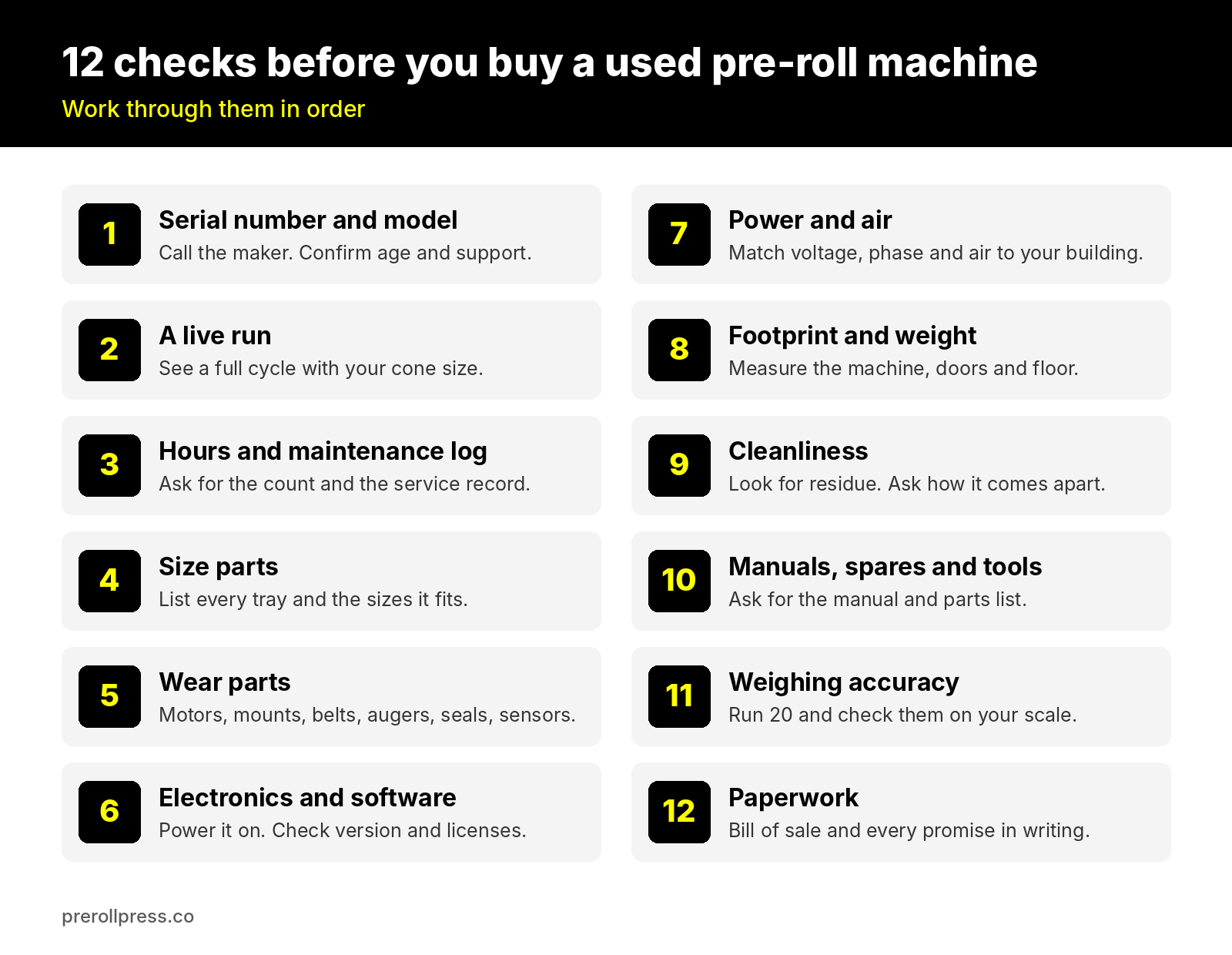
Check 12 things before you pay: the serial number, a live run, the hours, the size parts, the wear parts, the electronics, the power and air needs, the footprint, the cleanliness, the manuals, the weighing accuracy and the paperwork. Work through them in this order, because the early checks can end the deal before you spend money on travel.
| # | Check | How to do it | Walk away if |
|---|---|---|---|
| 1 | Serial number and model | Call the maker. Confirm the age, the original configuration and whether the model is still supported. | The maker cannot identify the machine or has stopped supporting it. |
| 2 | A live run | See the machine run a full cycle with your cone size. Bring your own ground material if the seller allows it. If you cannot travel, ask for an uncut video of a full cycle. | The seller will not run it or says it only needs a small fix. |
| 3 | Hours and maintenance log | Ask for the hour or cycle count and the written service record. | There is no log and nobody can say how it was maintained. |
| 4 | Size parts | List every tray, cartridge or change part included and the cone sizes each one fits. | The size you run is missing and the maker cannot supply it. |
| 5 | Wear parts | Look at motors, vibration mounts, belts, augers, seals and sensors. Ask which ones were replaced and when. | Wear parts are original on a high-hour machine and are no longer made. |
| 6 | Electronics and software | Power it on. Check the screen, the controller, the software version and any license tied to the first owner. | The software is locked, out of date or tied to the old owner's account. |
| 7 | Power and air | Compare the listed voltage, phase and compressed air needs with what your facility has. | Your building cannot supply it without major electrical work. |
| 8 | Footprint and weight | Measure the machine, your doorways and the floor space. Check the floor can take the weight. | It will not fit through the door or into the room. |
| 9 | Cleanliness | Look inside. Check for residue in hoppers, channels and trays, and ask how contact surfaces come apart for cleaning. | Residue is baked on or parts that touch material cannot be reached. |
| 10 | Manuals, spares and tools | Ask for the operator manual, the parts list, spare parts and any special tools. | There is no manual and the maker will not send one. |
| 11 | Weighing accuracy | If the machine weighs each pre-roll, run 20 and check them on your own scale. | Weights drift outside your tolerance and the seller cannot adjust it. |
| 12 | Paperwork | Get a bill of sale, proof the seller owns the machine free of liens, and every promise in writing. | The seller will not put the terms on paper. |
Check 9 matters more than buyers expect. A used machine carries the last operator's residue, and you do not know what was run through it. Regulators expect processing equipment to be cleanable. Washington's quality assurance rule for cannabis products, WAC 246-70-070, requires contact surfaces to be cleaned and sanitized regularly and equipment to be built so it can be cleaned properly. Rules differ by state, so read your own regulator's rule and plan a full teardown and cleaning before the first production run.
What costs are not in the asking price?
The asking price leaves out at least eight costs: freight, rigging, power and air work, missing size parts, wear parts, deep cleaning, training and downtime. On a large automated machine these can add up to a real share of the purchase price, so get a quote for each one before you make an offer.
| Cost | Why it applies to a used machine | How to price it |
|---|---|---|
| Crating and freight | Where-is terms put shipping on you. One dealer warns against LTL and common carriers for this type of machine. | Freight quote from the seller's location to yours, with insurance. |
| Rigging and installation | A machine eight feet long needs a forklift or riggers at both ends. | Quote from a local rigger. |
| Electrical and compressed air | Used automated machines on the market need anything from single-phase 230-volt power to 3-phase 480-volt power, and some need compressed air. | Quote from your electrician. Add a compressor if you do not have one. |
| Missing size parts | The machine comes with the sizes the last owner ran, not the sizes you run. | Maker's price for each tray or change part you need. |
| Wear parts | Motors, belts, seals and sensors may be near the end of their life. | Maker's parts price list. Budget for a first-year set. |
| Deep cleaning | Every surface that touches material has to be stripped and cleaned before you run product. | Your team's labor hours for a full teardown. |
| Training and commissioning | The seller's operators leave with their knowledge. The maker may charge to train a second owner. | Ask the maker for a service-visit quote. |
| Downtime | A used machine that stops has no warranty behind it. | Your lost output per day, times the maker's parts lead time. |
The power line is the one that surprises people. One used JuanaRoll 6 listing on Equipt specifies 3-phase, 480-volt power. Many small processing rooms do not have that, and bringing it in is a building project, not a plug.
Used vs new pre-roll machine: what does the math say?
At 50,000 pre-rolls a month, a new tray system costs far less than a used automated machine, even after you count the tray system's labor. The used machine only catches up at several hundred thousand pre-rolls a month.
Here is the arithmetic with every assumption shown. Change any line to your own numbers.
Worked example
Assumptions: 50,000 pre-rolls a month. The used machine is the 2024 automated unit listed at $100,000. The new machine is our Single Tray System with Metering Tray. One operator runs it at 837 pre-rolls an hour, the single-operator average in the Custom Cones USA test, which used 84mm half-gram cones. The wage is an example of $20 an hour, wage only. Use your own.
| Used automated machine | New tray system | |
|---|---|---|
| Purchase price | $100,000 asking price | $2,500 |
| Freight and setup | Not included. Get quotes. | Free ground shipping in the continental United States |
| Warranty | None unless the seller gives one in writing | Lifetime on parts and motors, one-year replacement on electronics |
| Machine cost per pre-roll over the first 12 months (600,000 pre-rolls) | $0.167 | $0.004 |
| Fill-and-close labor hours a month | Not known. Ask the maker. | 59.7 (50,000 divided by 837) |
| Fill-and-close labor cost a month | Not known. Ask the maker. | $1,195 (59.7 hours at $20) |
Result: the price gap is $97,500. The tray system's labor at this volume is $1,195 a month. Even if the used machine needed no labor at all, it would take about 82 months for that saving to cover the gap.
No automated machine runs with zero labor. Someone loads cones and material, clears jams and cleans it. So the real payback is longer than the figure above. The table below repeats the sum at five monthly volumes, using the same generous assumption.
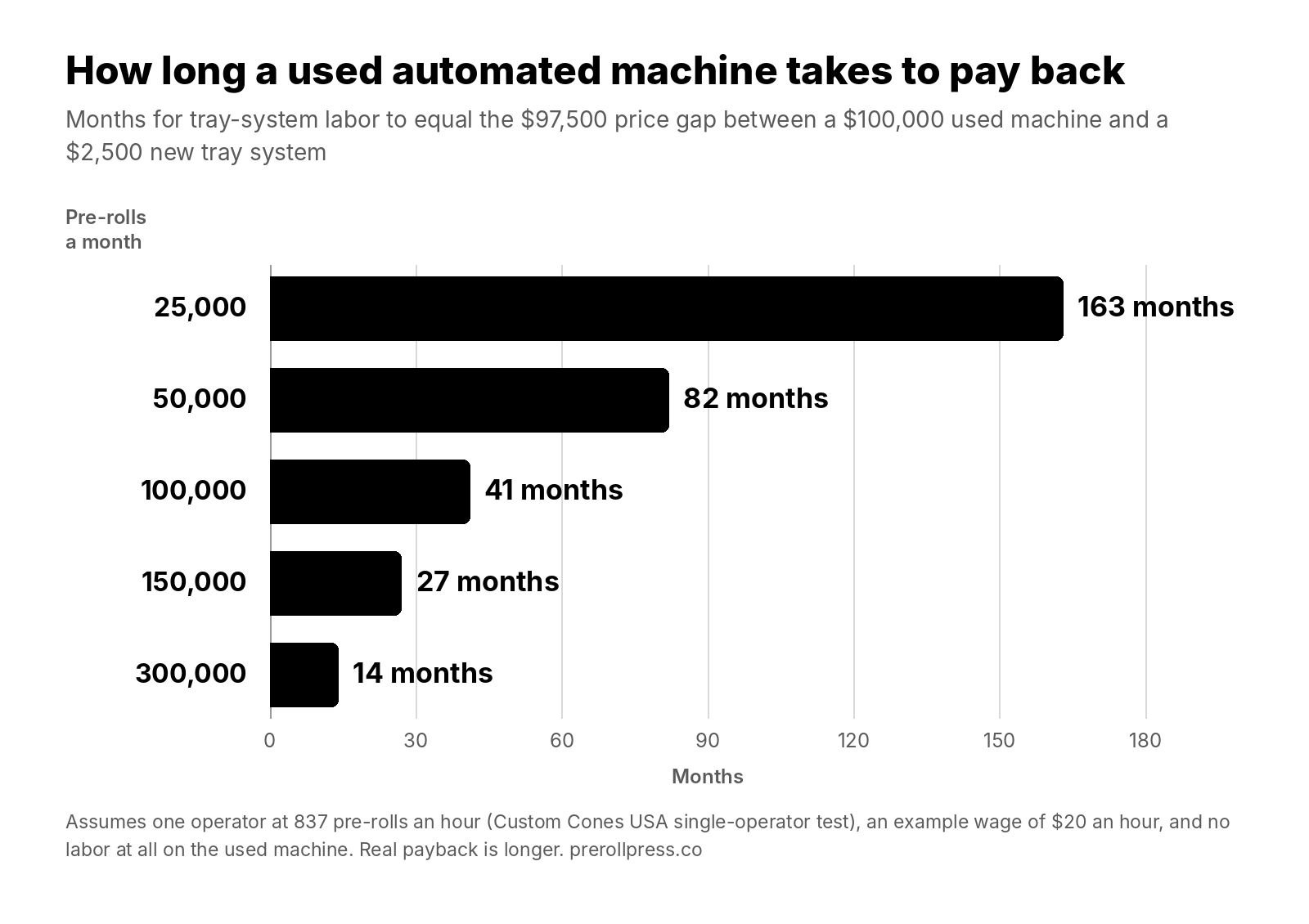
| Pre-rolls a month | Tray system operator hours a month | Tray system labor a month at $20 an hour | Months for that labor to equal the $97,500 price gap |
|---|---|---|---|
| 25,000 | 29.9 | $597 | 163 |
| 50,000 | 59.7 | $1,195 | 82 |
| 100,000 | 119.5 | $2,389 | 41 |
| 150,000 | 179.2 | $3,584 | 27 |
| 300,000 | 358.4 | $7,168 | 14 |
Read the table from the bottom up. At 300,000 pre-rolls a month the gap closes in about 14 months, and a used automated machine starts to make sense. At 25,000 a month it never does in any useful time frame.
There is one limit on the tray side to be straight about. A full-time month is about 173 hours. At 837 pre-rolls an hour, one operator on one shift tops out near 144,801 pre-rolls a month. Above that you add an operator, a tray or a shift, and the labor line grows with it. Our comparison of an automated pre-roll machine against a tray system works through that break-even at three wage levels.

Fill N' Fold Single Tray System with Metering Tray · $2,500
One 121-cone work tray with the metering tray, so every cone gets the same fill volume in one pass. It arrives new, complete and under warranty.
When is a used pre-roll machine the right choice?
A used pre-roll machine is the right choice when you need automated volume, the discount is deep, and you can verify the machine. Used is a sound way to buy in that case.
Used makes sense when most of these are true:
- You fill several hundred thousand pre-rolls a month, every month, and the volume is contracted or proven.
- The machine is a current model and the maker confirms parts and service for a second owner.
- The asking price is far enough below new to cover freight, setup, parts and a year of repairs.
- You have seen it run your cone size, on material like yours, at the output the seller claims.
- You need features a tray system does not have. A tray system does not weigh each cone or package the finished pre-roll. Some automated lines do both.
- Your building already has the power, the air and the floor space.
If you can tick five of those six, a used automated machine can be a good buy. If you can tick two, you are buying someone else's problem at a discount.
A used tabletop machine can also work as a spare. If you already run that model and know how to service it, a second-hand unit gives you backup parts and a standby machine for little money. As a first machine for a new line, it is a weaker choice.
When does a new tray system cost less than a used machine?
A new tray system costs less than a used machine whenever your volume is below the point where automation pays, which covers most small and mid-size pre-roll lines. At that size the purchase price is small, and the things you lose by buying used are worth more than the saving.
Here is what a tray system does, so you can judge it against a used machine. One 121-cone Fill N' Fold Work Tray holds 121 cones of a single size. The adjustable metering tray fills all 121 cones to the same volume in one pass. The packing base settles the material in every cone to the same density. The Fill N' Fold Press Tool then folds, tamps and Dutch Crowns 11 pre-rolls per press. One operator can fill, pack and close up to 121 pre-rolls in under 10 minutes.

| Used machine | New Fill N' Fold tray system | |
|---|---|---|
| Price | Whatever the seller will take | Listed on the product page |
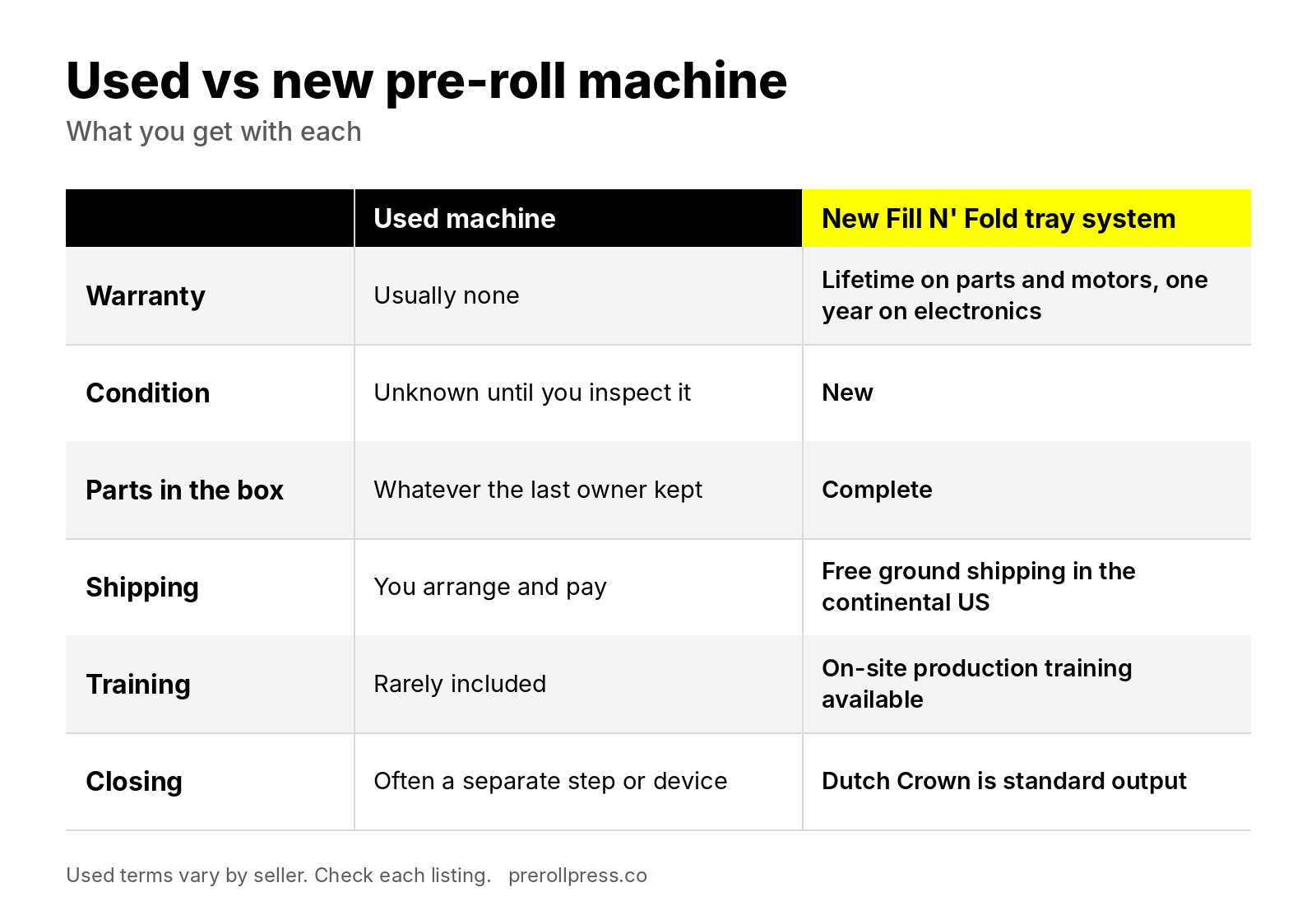
| Warranty | Usually none | Lifetime on parts and motors, one-year replacement on electronics |
| Condition | Unknown until you inspect it | New |
| Parts in the box | Whatever the last owner kept | Complete |
| Shipping | You arrange and pay | Free ground shipping in the continental United States |
| Training | Rarely included | On-site production training available |
| Closing | Depends on the machine. Often a separate step or device. | Dutch Crown is standard output |
| Help when it stops | Depends on the maker's policy for second owners | Call 509-701-0035 |
The closing line deserves a second look. Many tabletop machines fill cones and leave the closing to your team. Closing by hand is often the slowest step on the line, so a cheap used filler can leave you with the same bottleneck you had before. Our comparison of pre-roll closing machines and methods shows what each closing option costs.
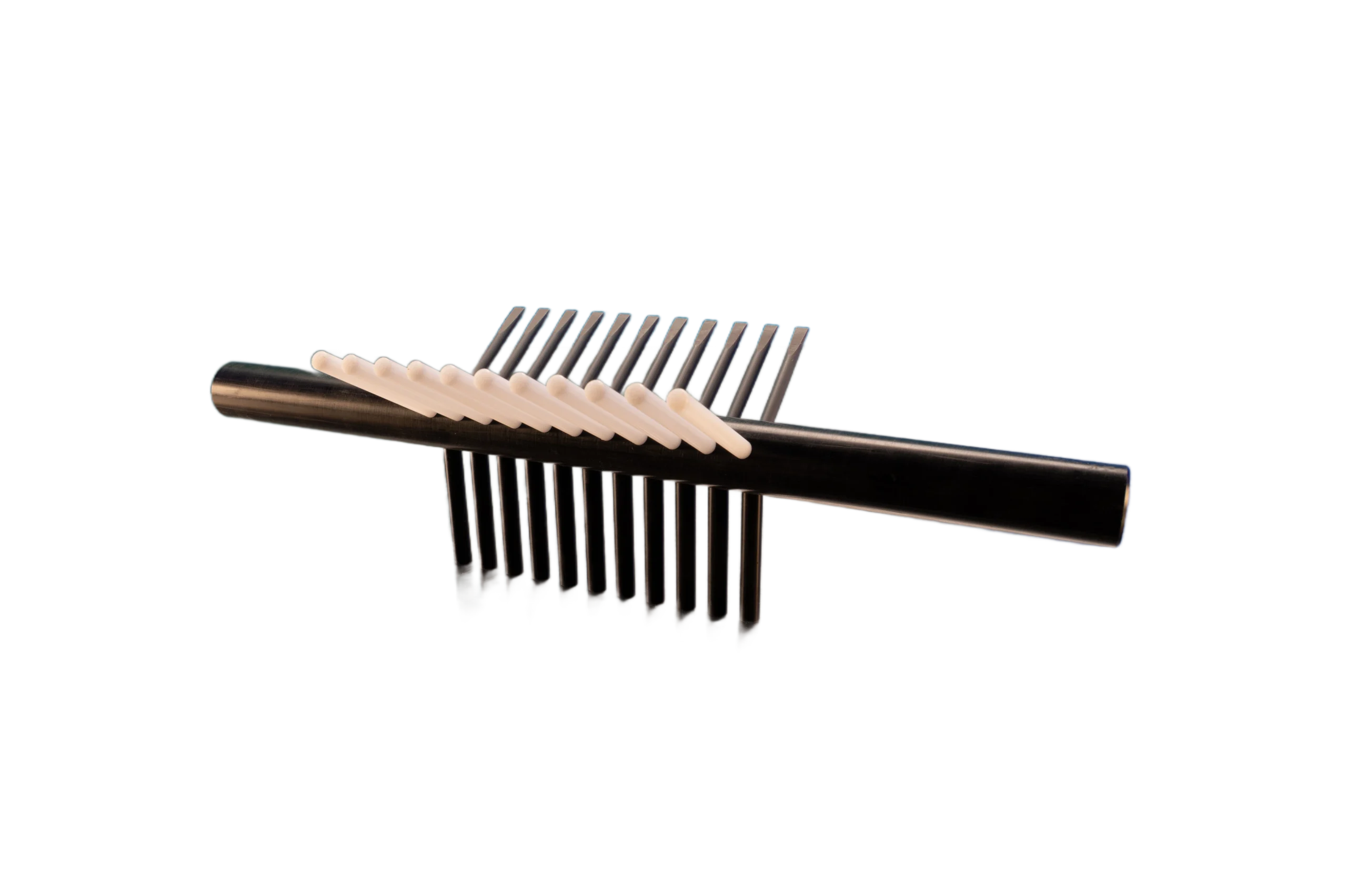
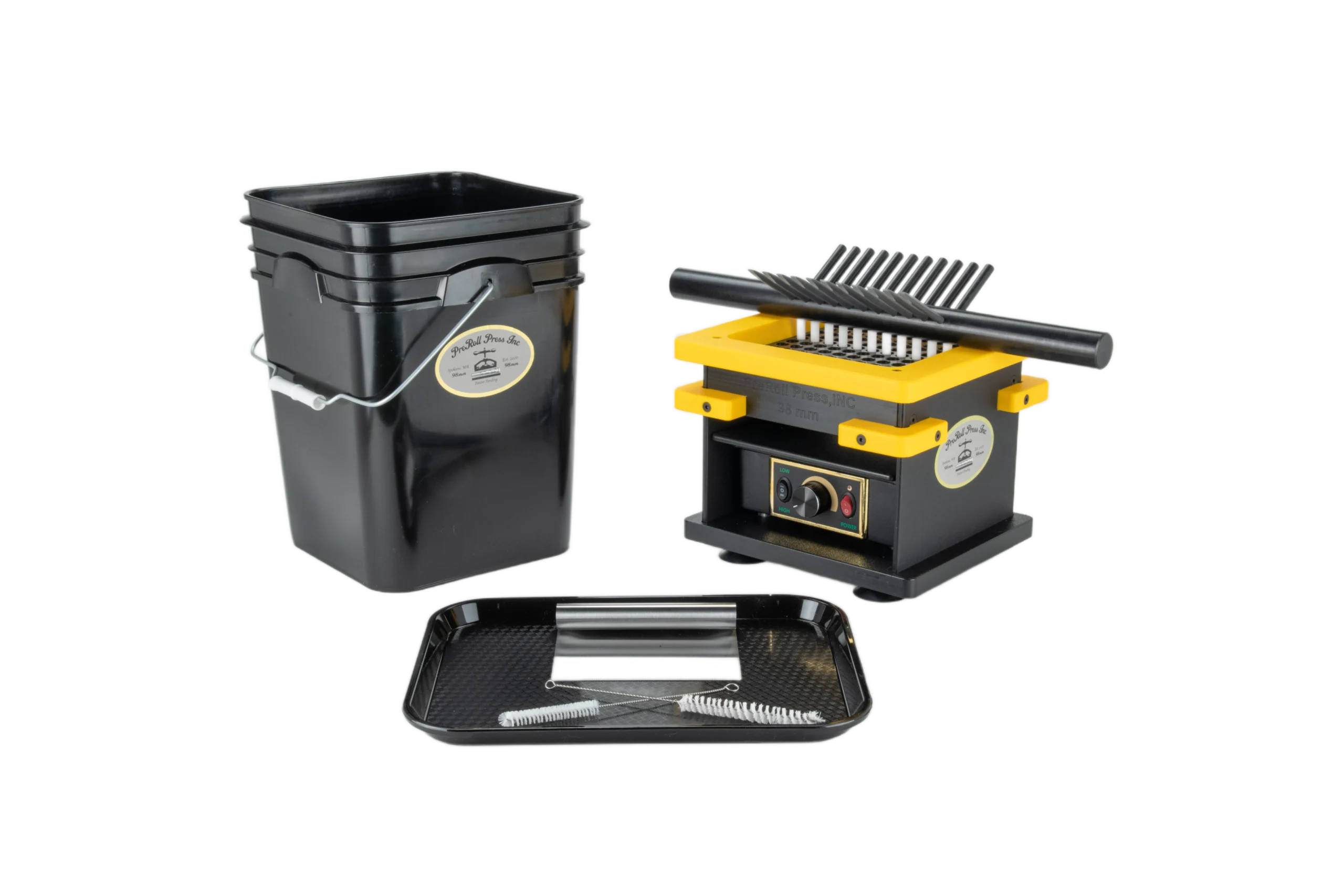
Fill N' Fold Single Tray System · $1,850
The lowest-cost way into a new Fill N' Fold. One 121-cone work tray, sold without the metering tray, for an operation that is starting out.
Not sure which size fits your volume? Our guide to choosing the right Fill N' Fold system matches each system to a daily target. You can also see what operators say on our customer testimonials page.
Bought a used Knockbox? How to add a Dutch Crown finish
If you already bought a used Futurola Knockbox or Thumper, you can add a Dutch Crown finish to it with a Press 100 kit. You keep the machine you own and remove the hand-closing step.
The Knockbox is one of the most popular tabletop machines, and it is a sound filler. It fills the cones and leaves the closing to you. In the Custom Cones USA test, its cones were closed by hand with a twist. Each Press 100 kit pairs a Press 100 work tray with a press tool, so the cones are folded and crowned in rows and not twisted one at a time. Work trays come in 109mm, 98mm and 84mm sizes.
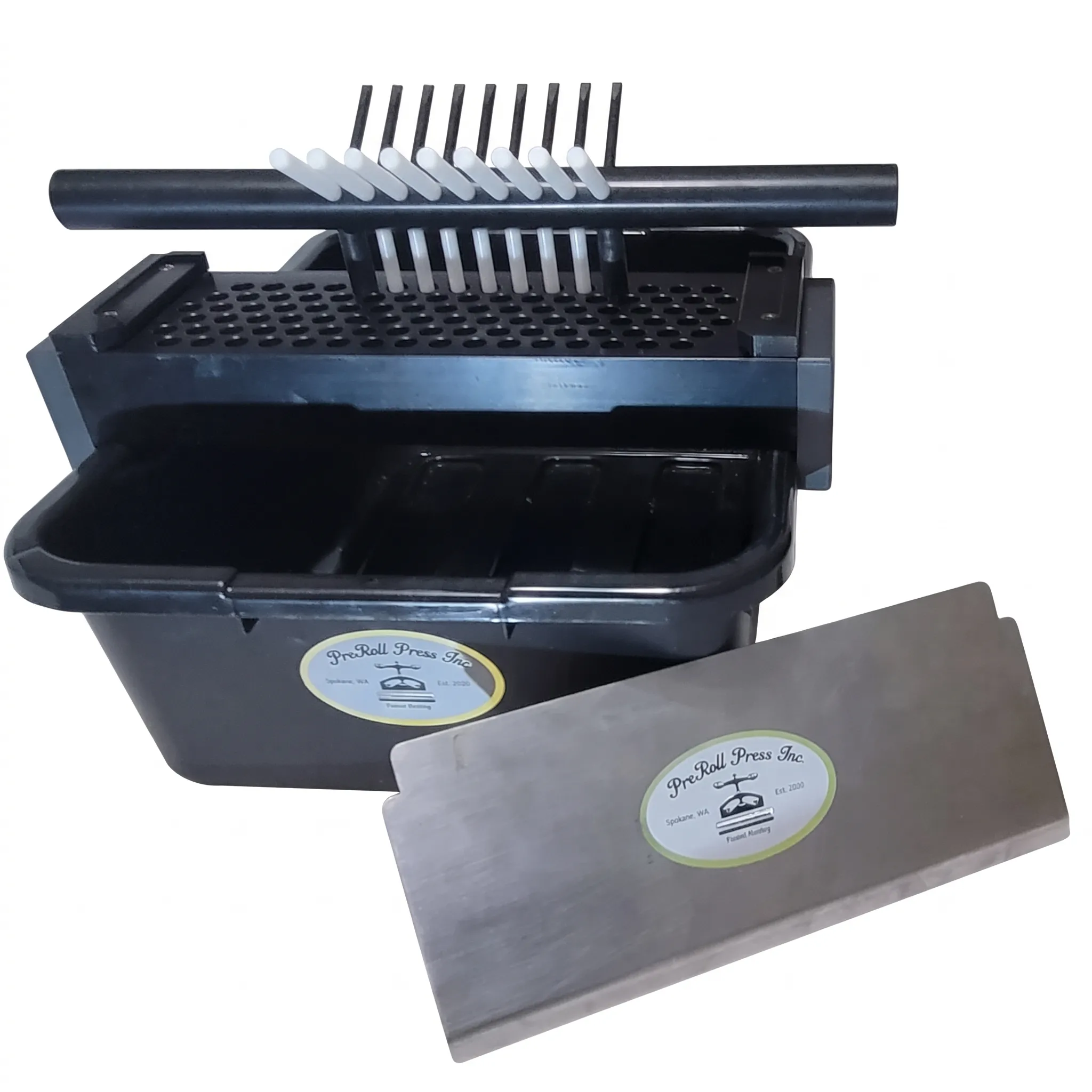
Press 100 Single Tray Package · $1,800
One Press 100 work tray and one press tool for a Futurola Knockbox or Thumper you already run. It adds the Dutch Crown close without replacing the machine.
Before you buy a used Knockbox, check which filling kits come with it and whether they match your cone sizes. Our guide to the Futurola Knockbox 100, its manual and parts lists what a complete machine should include. The full range of Press 100 kits for the Futurola Knockbox is on our site.
What questions should you ask the seller?
Ask the seller these 10 questions in writing, and keep the answers. A seller who answers all of them plainly is usually a seller worth dealing with.
- What is the model, serial number and year of manufacture?
- How many hours or cycles has it run, and can I see the maintenance log?
- Why are you selling it?
- When did it last run production, and how has it been stored since?
- Which cone sizes does it come set up for, and which trays or change parts are included?
- Which parts have been replaced, and which are due?
- What power and compressed air does it need?
- Can I see it run a full cycle, in person or on an uncut video?
- Is any warranty or service plan still active, and has the maker confirmed it transfers?
- Will you put the price, what is included and the condition in a signed bill of sale?
If the answers leave you unsure, compare the offer with a new machine before you commit. The full range of Fill N' Fold pre-roll machines is listed with prices, and our overview of pre-roll cone filling machines explains how the main types differ.
Frequently asked questions
How much does a used pre-roll machine cost?
It depends on the machine type. Recent listings for used automated pre-roll machines ask around $100,000, including a 2024 Procepack PreRoll-Er 200 at $100,000 and a 2022 Weighpack JuanaRoll at 98,000 euros. Used tabletop machines cost far less, but their new prices are low enough that the saving is small. Always add freight, setup and parts to the asking price.
Is it safe to buy a used pre-roll machine?
It can be, if you check it first. Most used machines sell as-is with no warranty and no returns, so the risk is yours once you pay. See the machine run with your cone size, call the maker with the serial number, ask for the maintenance log, and get every promise from the seller in writing.
Does the warranty transfer when you buy a used pre-roll machine?
Often not. Some equipment warranties cover the original buyer only and end when the machine is resold. Read the maker's warranty text and call the maker with the serial number before you pay. If the seller says the machine is still covered, ask for that in writing from the maker, not from the seller.
Where can I find a used pre-roll machine for sale?
Used pre-roll machines are listed by used equipment dealers such as Sigma Equipment and Equipt, on industrial marketplaces such as Surplus Record, by cannabis equipment liquidators, on industry forums, and on eBay. Operators who are closing or upgrading also sell direct. Dealers give you more paperwork. Direct sales are cheaper but carry more risk.
Is a refurbished pre-roll machine better than a used one?
Only if the seller can prove the work. Refurbished has no fixed meaning. Ask for a written list of the parts that were replaced, who did the work, how the machine was tested, and what warranty comes with it. A refurbished machine with no written warranty carries the same risk as any other used machine.
Should I buy a used pre-roll machine or a new one?
Buy used when you need a large automated line, the discount is deep, and the maker still supports the model. Buy new when you are looking at a tabletop or tray system. New prices there are low, and you get the warranty, the training and every part in the box. Run the numbers for your own monthly volume before you decide.
Weighing a used machine against a new one? Tell us how many pre-rolls you need and which sizes, and we will tell you which system fits. Call 509-701-0035.