
A pre-roll closing machine folds or twists the open end of a filled cone so the material stays in. Options run from a hand press tool that Dutch Crowns 11 cones per press to automated closers that fold 72 cones per cycle. The right one depends on your daily volume, your cone sizes and the filling machine you already own.
Key takeaways
- Closing is the slow step on most lines. In a Custom Cones USA test, one operator finished 837 Dutch Crown pre-rolls an hour with a row tool and 529 to 585 an hour when twisting by hand.
- There are four ways to close at scale: by hand, with a row tool, with a tray press, or with a standalone automated closer.
- Published prices for the closers in this guide run from $400 to about $59,995.
- Most closers fit one brand of tray. Check the fit with your filling machine before you compare speed.
- Spread over the first 100,000 pre-rolls, the purchase price works out to under half a cent each for a press tool and about 60 cents each for the highest-priced closer.
In this guide
- What is a pre-roll closing machine?
- Why does closing set your line speed?
- Twist or Dutch Crown: which finish does each machine make?
- What are the four ways to close pre-rolls at scale?
- How do pre-roll closing machines compare on price and speed?
- What does a closing machine cost per pre-roll?
- How do you close pre-rolls on a Fill N' Fold?
- How do you close pre-rolls on a Knockbox or Thumper?
- When is a standalone automated closer the right buy?
- What should you check before you buy a closing machine?
- Frequently asked questions
What is a pre-roll closing machine?
A pre-roll closing machine is any tool or machine that closes the open end of a filled cone without a person folding or twisting each one by hand. Some close a row at a time, some close a full tray, and some run a timed automatic cycle.
This guide covers the closing step only. If the finish itself is new to you, start with our explanation of what a Dutch Crown pre-roll is and why operators are switching. If you are choosing a whole line, our comparison of automated pre-roll machines and tray systems covers filling as well.
Closing is the last step before a pre-roll goes into its pack. The cone has been loaded, filled and packed. A short length of empty paper is left above the material, and that paper has to be shut. A closer does one of two things with it: folds it down flat into a Dutch Crown, or twists it into a wick. Most also tamp the top in the same motion.
A note on names. Sellers call these machines closers, crowners, folders, twisters and finishing modules. Operators usually search for a pre-roll closing machine or a pre-roll twisting machine. All of those names describe the same job.
Why does closing set your line speed?
Closing sets your line speed because it is the one step most filling machines leave to hands. A vibration tray fills 100 or more cones in one cycle. Closing those same cones one at a time takes far longer than filling them did.
Custom Cones USA measured this in its 2025 pre-roll cone filling machine report. Three tabletop machines were run through full cycles, and the finished pre-rolls were counted per hour with closing included.
| Machine | Cones per cycle | How the cones were closed | Finished per hour, one operator | Finished per hour, two operators and spare parts |
|---|---|---|---|---|
| Fill N' Fold | 121 | Dutch Crown, row tool | 837 | 1,361 |
| King Kone | 169 | Twist, by hand | 585 | 1,170 |
| Futurola Knockbox 100 | 100 | Twist, by hand | 529 | 1,000 |
Source: Custom Cones USA, April 2025. The test measured whole cycles. It is not a verdict on machine quality. The King Kone and the Knockbox were closed by hand in the test, and both makers now sell a closing device, covered below.
The King Kone holds 48 more cones per cycle than the Fill N' Fold and still finished 252 fewer pre-rolls an hour with one operator. The difference was the close. The number of holes in a tray matters less than how fast you can shut what is in them.
The lesson for a buyer is simple. Measure finished pre-rolls per hour, not cones filled per cycle. Your line runs at the speed of its slowest station, and on most lines that station is closing.
Twist or Dutch Crown: which finish does each machine make?
Closing machines make one of two finishes, and most make only one. A Dutch Crown machine folds the empty paper flat over the material. A twisting machine grips the paper, turns it and usually trims the tail.
| Finish | How the machine makes it | What you get | Closers in this guide |
|---|---|---|---|
| Dutch Crown | Pins push the empty paper inward and down, then tamp the top | A flat, folded top with no tail | Fill N' Fold Press Tool, Pneumatic Press, Press 100, King Kone Closer, Futurola Dutch Crown Device, STM RollCraft ATC, STM Atomic Closer |
| Twist | Grippers turn the paper and a blade cuts the excess | A twisted wick, the look of a hand-rolled joint | ActionPac TwistMaster420 |
Pick the finish before you pick the machine. Your packaging, your retail buyers and your brand decide it, and switching later usually means switching equipment. We compare the two finishes for retail in Dutch Crown vs twisted pre-rolls.
Both finishes need the right amount of empty paper above the material. Too little and the fold will not hold. Too much and the crown sits low or the twist runs long. That height is set at the packing step, before any closer touches the cone. On our system the Fill N' Fold Packing Base settles material in all 121 cones to the same density, so the paper left to fold is the same from cone to cone.
Closing cannot fix a bad pack. If your pre-rolls burn down one side, the place to look is upstream, and our guide to why pre-rolls canoe and how to prevent it covers the causes.
What are the four ways to close pre-rolls at scale?
There are four ways to close pre-rolls at scale: by hand, with a row tool, with a tray press, and with a standalone automated closer. Each step up closes more cones per motion and costs more to buy.
| Method | Cones closed per motion | What the operator does | Typical fit |
|---|---|---|---|
| By hand | 1 | Folds or twists every cone | Small batches, samples, specialty SKUs |
| Row tool | 11 on the Fill N' Fold | Presses down row by row, 11 presses per 121-cone tray | Tabletop lines of any size |
| Tray press | A full tray: 100, 121 or 169 cones depending on the brand | Positions the tray, then pulls a lever or starts the press | Lines where closing is still the slow step |
| Standalone automated closer | 72 per timed cycle on the STM Canna models | Loads trays, starts the cycle, unloads | High daily volume with a dedicated closing station |
Closing by hand
Hand closing costs nothing to start and the most to keep running. One person closes one cone per motion. That works for small runs. At volume it becomes the largest block of labor on the line, and the finish depends on who is closing that day.
Row tools
A row tool closes a full row of cones in one press while the cones stay in the tray you filled them in. The Fill N' Fold Press Tool folds, tamps and Dutch Crowns 11 pre-rolls per press, so a 121-cone tray closes in 11 presses. There is no transfer, no second station and no air or power to connect.

The Fill N' Fold Press Tool, large size, for 109mm and 98mm work trays.
Tray presses
A tray press closes every cone in the tray in one action. The King Kone Closer does it with a lever for a 169-cone King Kone tray. The Futurola Dutch Crown Device does it for a 100-cone Knockbox tray. Our Pneumatic Press closes, tamps and ejects an entire Fill N' Fold work tray at once.
Standalone automated closers
A standalone automated closer is a separate machine with its own trays and a timed cycle. Filled cones go in, the cycle runs, and closed pre-rolls come out. The RollCraft ATC and the Atomic Closer from STM Canna are two examples. The TwistMaster420 from ActionPac is the twisting equivalent.
How do pre-roll closing machines compare on price and speed?
Closing machines on the market today run from a hand tool to a five-figure automated module, and the published speeds are not all measured the same way. The table below uses each maker's or seller's own figures.
| Closer | Made by | Finish | Cones per press or cycle | Published speed | Price | Works with |
|---|---|---|---|---|---|---|
| Fill N' Fold Press Tool | PreRoll Press | Dutch Crown | 11 per press | 11 presses per 121-cone tray | $425 | Fill N' Fold work trays. Large tool for 109mm and 98mm, small for 84mm and 70mm |
| Pneumatic Press | PreRoll Press | Dutch Crown | A full work tray | Our product page states closing time cut by as much as 50% | $15,000 | Fill N' Fold work trays. Contact us for availability |
| Press 100 Tool | PreRoll Press | Dutch Crown | Not published | Not published | $400 for the tool, $1,800 for the single tray package | Futurola Knockbox and Thumper. Work trays in 109mm, 98mm and 84mm |
| King Kone Closer | King Kone | Dutch Crown | Up to 169, one lever pull | No hourly figure on the listing we read | About $1,664 | King Kone closing trays, sold separately for each size |
| Futurola Dutch Crown Device | Futurola | Dutch Crown | 100 | No hourly figure published | About $2,188 | Futurola Knockbox 100. One device per cone size |
| STM RollCraft ATC | STM Canna | Dutch Crown | 72 per cycle | Up to 2,100 an hour | About $24,995 | 70mm, 84mm, 98mm and 109mm cones |
| STM Atomic Closer 2.0 | STM Canna | Dutch Crown | 72 per cycle | Cycle listed at about 40 seconds | About $59,995 | STM RocketBox and Mini-RocketBox trays |
| ActionPac TwistMaster420 | ActionPac | Twist | A 240-cone tray | Up to 2,400 an hour | Not published | ActionPac RollMaster420 |
Competitor figures were read on November 21, 2026. Sources: Hydrobuilder and MJ Wholesale listings for the Atomic Closer, Cannabis Equipment News (June 2026) for the RollCraft ATC, Custom Cones USA for the King Kone Closer, Hydrobuilder for the Futurola Dutch Crown Device, and Cannabis Equipment News (November 2022) and ActionPac's MJBizCon listing for the TwistMaster420. Competitor prices are approximate; confirm current pricing with the seller.
How to read the speed column
Published speeds are closing-only figures. None of them include loading the closer, moving trays between stations or clearing a jam. Sellers also disagree with each other. The hourly figures we found for the Atomic Closer changed from one listing to the next, so this table gives its cycle figure only.
Ask every seller the same question: how many finished pre-rolls an hour, with one operator, on my cone size? That is the number the Custom Cones USA test measured, and it is the only one you can compare across machines.
This comparison is about fit and cost. It is not a judgment of any machine's build quality.
What does a closing machine cost per pre-roll?
Spread over the pre-rolls it closes, the purchase price of a closer runs from a fraction of a cent to tens of cents each across the first 100,000 units. The math is the price divided by the number of pre-rolls closed.
| Closer | Price | Per pre-roll, first 100,000 | Per pre-roll, first 1,000,000 |
|---|---|---|---|
| Fill N' Fold Press Tool | $425 | 0.4 cents | 0.04 cents |
| King Kone Closer | About $1,664 | 1.7 cents | 0.17 cents |
| Futurola Dutch Crown Device | About $2,188 | 2.2 cents | 0.22 cents |
| Pneumatic Press | $15,000 | 15 cents | 1.5 cents |
| STM RollCraft ATC | About $24,995 | 25 cents | 2.5 cents |
| STM Atomic Closer 2.0 | About $59,995 | 60 cents | 6 cents |
These figures cover the purchase price only. Trays for extra cone sizes, air supply, shipping, maintenance and labor are extra. Competitor prices are approximate; confirm current pricing with the seller.
Price per pre-roll is half the picture. The other half is the labor each closer removes, and that depends on how you close today. Work it out with your own numbers before you talk to any seller.
Worked example
Assumptions: you close 5,000 cones a day by hand, each one takes 4 seconds, and closing labor costs you $20 an hour. Replace all three with your own figures.
5,000 cones x 4 seconds = 20,000 seconds, or about 5.6 hours of closing every day.
5.6 hours x $20 = about $111 a day, or about $2,333 across 21 working days.
With a row tool that closes 11 cones per press, the same 5,000 cones take 455 presses in place of 5,000 separate closes. Time your own crew on one full tray, multiply it out, and set the saving against the prices in the table above.
Two things follow from the math. At a few thousand pre-rolls a day, a row tool or a lever press takes away most of the single-cone motions for a small share of what an automated closer costs. At tens of thousands a day, the price per pre-roll of a timed closer falls quickly and the labor it removes grows.
What the purchase price leaves out
The price tag is one line of the real cost. Every extra cone size usually needs its own tray or tooling. A second station needs bench space and someone to move trays to it. A machine with motors, sensors or air cylinders needs maintenance and, sooner or later, parts. Ask for the cost of a second cone size and the warranty terms before you compare two quotes.
How do you close pre-rolls on a Fill N' Fold?
On a Fill N' Fold, closing happens in the same work tray the cones were filled in, so there is no separate closing station to buy first. Dutch Crown is standard output on the system. On several other machines it is a separate device or step.
The sequence is load papers, meter, pack, crimp, tamp and eject. One Fill N' Fold Work Tray holds 121 cones of a single size. Up to 121 pre-rolls are filled, packed and Dutch Crown-closed in under 10 minutes with one operator. We walk through a full production run in how to make Dutch Crown joints at scale.

Fill N' Fold work trays. Each one holds 121 cones of a single size.
The work tray and the method are covered by US patent 12,414,584, which describes filling, packing, closing and ejecting cones from one plate.
Closing row by row with the press tool
The press tool is the standard way to close on our system. You set it on a row, press down, and 11 cones are folded, tamped and crowned. Move to the next row and repeat. A full tray takes 11 presses.
Fill N' Fold Press Tool · $425
Folds, tamps and Dutch Crowns 11 pre-rolls per press. The large tool fits 109mm and 98mm work trays, the small tool fits 84mm and 70mm.
Pressing twice for a tighter tip
If you want a firmer pack and a deeper dimple, press twice. A work tray sits on top of a Double Dutch tray one size smaller. Pre-rolls are pressed from the first tray into the second, then tamped and pressed out again. The Fold Plate is a related add-on that crimps and folds all 121 tops at once, so the press tool only has to tamp and crown. The Fold Plate was out of stock when we wrote this, so check availability with us.
Double Dutch Press Work Tray · $850
Lets a pre-roll be pressed twice for a tighter pack and a cleaner tip.
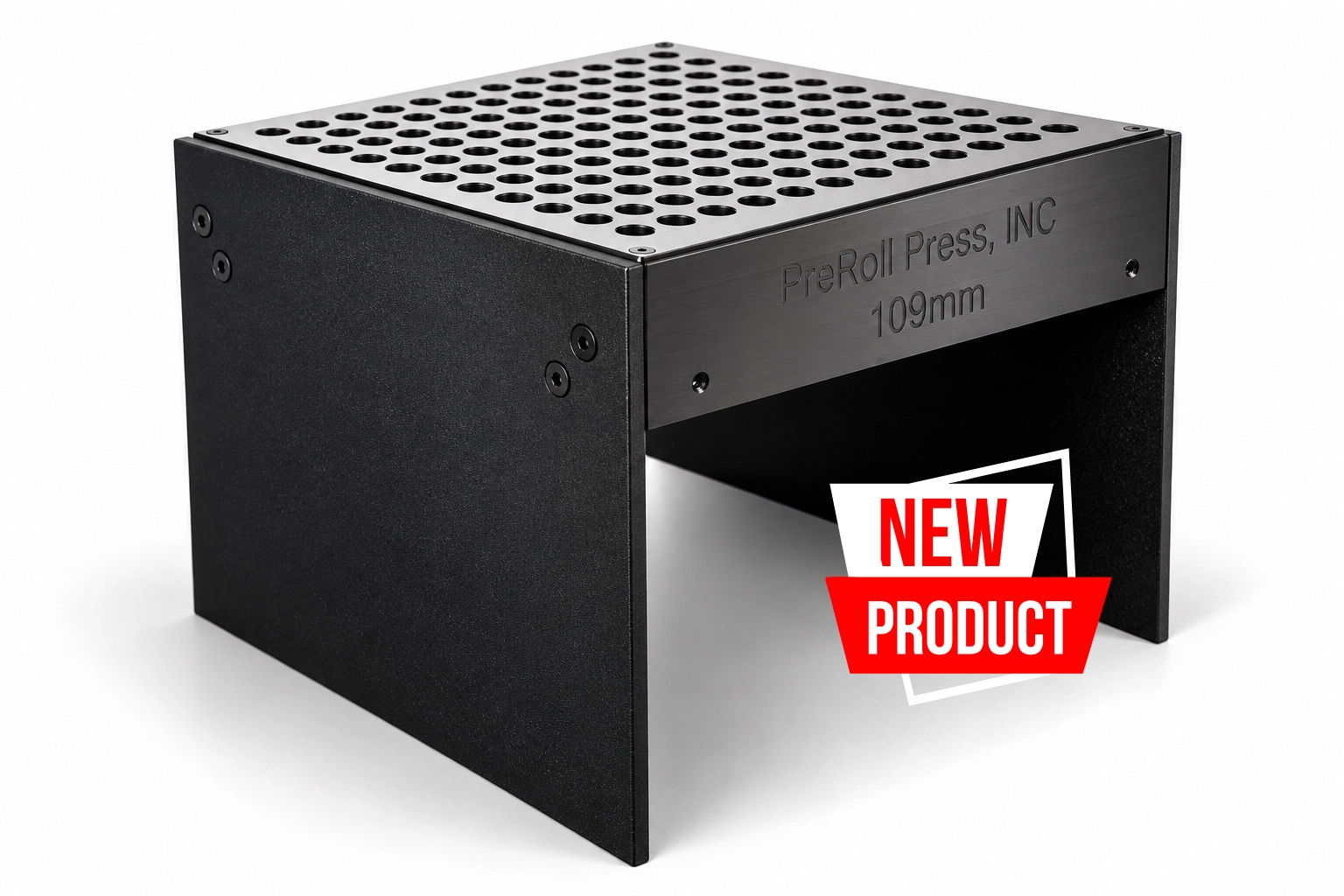
The Double Dutch Press Work Tray sits under a work tray one size larger.
Closing a whole tray at once
When the press tool becomes your slow step, the Pneumatic Press closes, tamps and ejects an entire work tray in one action. Our product page states it can cut closing time by as much as 50%. We do not publish an hourly figure for it, so ask us to show it running on your cone size.
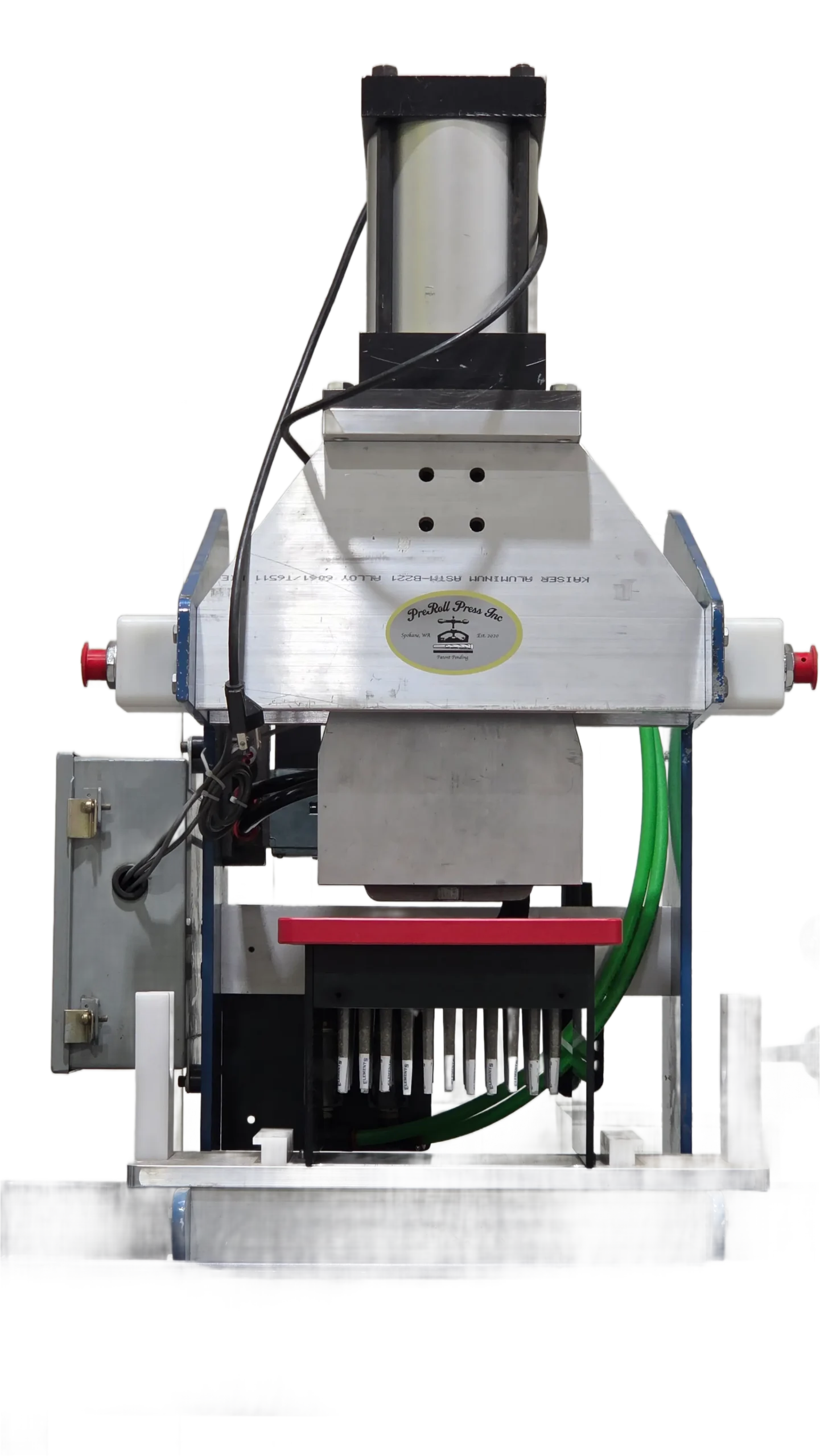
The Pneumatic Press closes a full work tray in one action.
Pneumatic Press · $15,000
Closes, tamps and ejects a full Fill N' Fold work tray at once. Contact us for availability and timeline.
If you do not own a system yet, compare the tray counts on our Fill N' Fold pre-roll machines page. The Fill N' Fold All-In System includes 4 work trays and 2 press tools, one large and one small, so every size from 70mm to 109mm can be closed from day one.
How do you close pre-rolls on a Knockbox or Thumper?
If you already run a Futurola Knockbox or Thumper, you can add a Dutch Crown finish without replacing the machine. There are two routes: Futurola's own Dutch Crown Device, and our Press 100 kits.
The Knockbox fills well. What it leaves open is the close, and in the Custom Cones USA test that close was a hand twist. Our Press 100 kits for the Futurola Knockbox add the Dutch Crown to the machine you already run. Each kit pairs a Press 100 work tray with a press tool. Work trays come in 109mm, 98mm and 84mm.
Press 100 Single Tray Package · $1,800
One Press 100 work tray, one press tool and one catch bin, for adding a Dutch Crown to a Knockbox or Thumper.
Press 100 Single Tray Package for Knockbox and Thumper owners
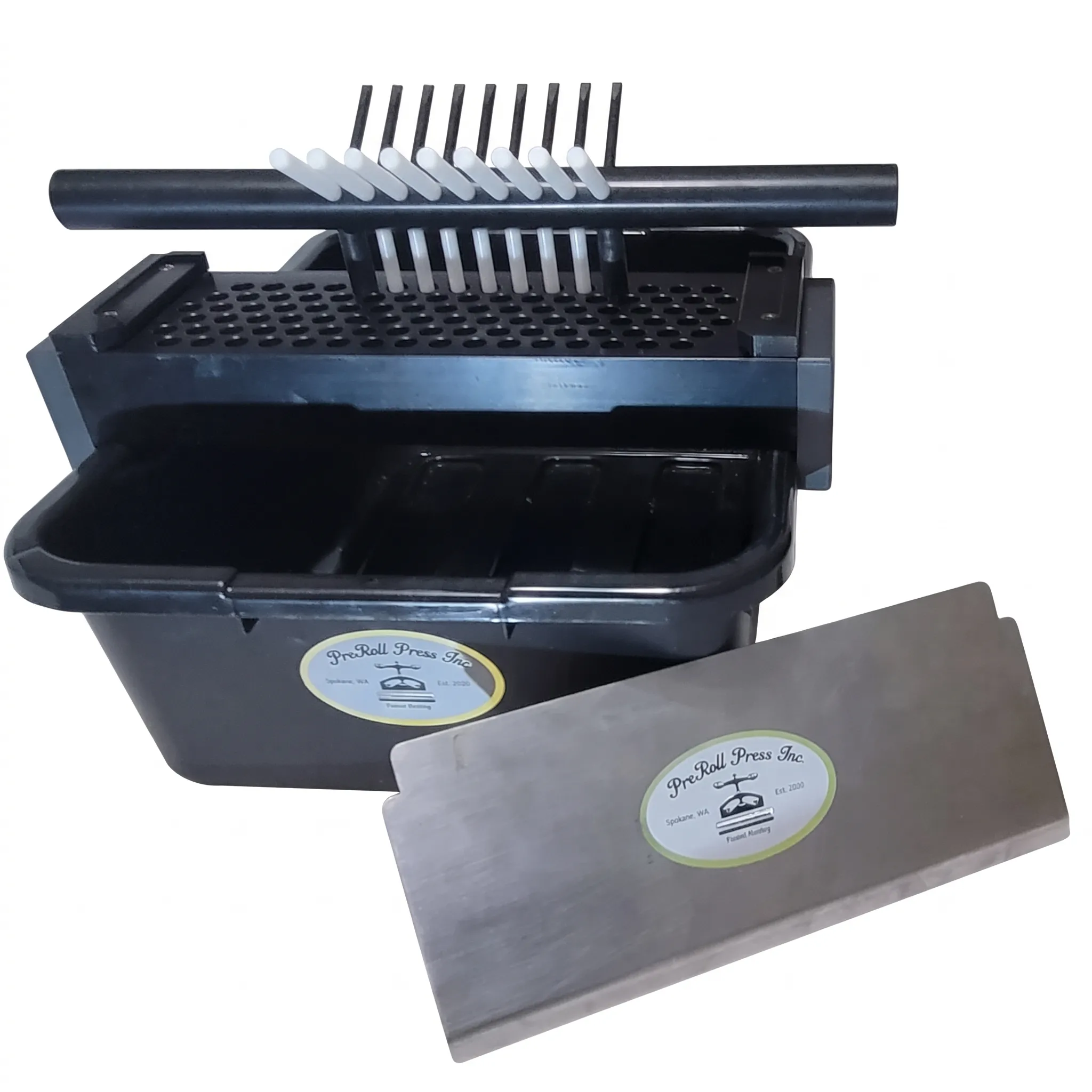
The Press 100 Single Tray Package: work tray, press tool and catch bin.
Futurola's Dutch Crown Device closes a 100-cone Knockbox tray, with a separate device for each cone size. Either route keeps the filling machine you have. Compare the two on the cone sizes you run, the price of each extra size and how the finished crown looks on your paper.
For setup, parts and maintenance on the machine itself, see our Futurola Knockbox 100 guide to the manual, parts and upgrades.
When is a standalone automated closer the right buy?
A standalone automated closer is the right buy when your closing volume is high and steady enough to keep a dedicated station busy every shift, and when its trays match your filler. Below that volume the machine sits idle between batches.
An automated closer does three things well. Its timed cycle does not tire. It puts the same fold on every cone. One operator can feed it. At very high volumes it will out-close a hand tool, and for some operations it is the correct machine.
Weigh four things against that before you sign.
Tray fit. Most automated closers are built around their maker's own filling trays. If your filler is a different brand, ask how filled cones get into the closer and how long that transfer takes per tray.
Changeover. Each cone size needs its own tooling. If you run four SKUs in a day, ask for the changeover time in minutes and count it against the cycle time.
Utilities and space. A closer is a second station with its own footprint, and some need compressed air. Get the air, power and bench requirements in writing.
Where the slow step moves. Once closing is quick, loading cones usually becomes the limit. On our system the Fill N Fold Pre-Roll Cone Dispenser holds 121 stacks of cones and loads a full tray in one drop.

The Fill N Fold Pre-Roll Cone Dispenser loads a full tray in one drop.
A tray system is not for everyone. If you need tens of thousands of closed pre-rolls every day from one station, a timed closer or a fully automated line will out-produce any hand-pressed tool. It also costs many times more and takes longer to change over between sizes.
What should you check before you buy a closing machine?
Check seven things before you buy: the finish, the tray fit, the cone sizes, the finished output per hour, the utilities, the changeover time and the warranty. Put the same questions to every seller and compare the answers side by side.
| Question to ask | Why it matters |
|---|---|
| Which finish does it make? | Dutch Crown and twist need different machines. |
| Does it fit my filling trays? | A closer that needs cones moved by hand adds a step and a place to spill. |
| Which cone sizes, and what does each extra size cost? | Size-specific trays and tools add to the price. |
| How many finished pre-rolls an hour with one operator? | Cycle time alone leaves out loading and unloading. |
| What does it need: air, power, bench space? | These are costs the price tag leaves out. |
| How long is a size changeover? | Short runs lose more time to changeovers than to closing. |
| What is the warranty, and who answers the phone? | A closer that is down stops the whole line. |
For our own equipment the answers are short. The warranty is lifetime on parts and motors and one-year replacement on electronics. Every press is built and serviced in Spokane, WA. Ground shipping is free in the continental US, and on-site production training is available.
Every closing add-on in this guide is listed with the rest of our Fill N' Fold add-ons. For the finish itself, go back to our guide to the Dutch Crown pre-roll.
Frequently asked questions
What is a pre-roll closing machine?
A pre-roll closing machine closes the open end of a filled cone by folding the paper into a Dutch Crown or twisting it into a wick. Types range from hand press tools that close a row of cones per press, to lever and pneumatic presses that close a full tray, to automated closers that run a timed cycle.
How much does a pre-roll closing machine cost?
Published prices run from $400 to $425 for a PreRoll Press press tool, through about $1,664 to $2,188 for tray closers from King Kone and Futurola, $15,000 for the PreRoll Press Pneumatic Press, and about $24,995 to $59,995 for STM Canna's automated closers. Competitor prices are approximate. Trays, shipping and air supply are usually extra.
How many pre-rolls can a closing machine close per hour?
It depends on the type and on who measured it. In a Custom Cones USA test, one operator finished 837 Dutch Crown pre-rolls an hour on a Fill N' Fold, closing included. STM Canna's RollCraft ATC is listed at up to 2,100 an hour and the ActionPac TwistMaster420 at up to 2,400 an hour, both for closing only.
Is there a machine that twists pre-rolls?
Yes. Twisting machines grip the empty paper, turn it and trim the tail. The ActionPac TwistMaster420 is a standalone example, listed at up to 2,400 pre-rolls an hour. Some fully automated filling lines also twist as a built-in step. Most tabletop closers make a Dutch Crown fold instead, so choose the finish before you choose the machine.
Can I add a Dutch Crown closer to a Knockbox?
Yes. Futurola sells a Dutch Crown Device for the Knockbox 100, with a separate device for each cone size. PreRoll Press sells Press 100 kits for the Futurola Knockbox and Thumper, which pair a Press 100 work tray with a press tool. Work trays come in 109mm, 98mm and 84mm. Both routes keep the filling machine you already own.
Do I need a separate closing machine if I use a Fill N' Fold?
No. Dutch Crown closing is part of the Fill N' Fold cycle. The press tool folds, tamps and crowns 11 pre-rolls per press in the same 121-cone work tray used for filling, so a tray closes in 11 presses. If closing becomes your slow step later, the Pneumatic Press closes, tamps and ejects a full work tray at once.
Dutch Crown or twist: which closes faster?
By hand, a twist is the simpler motion. With tooling the fold catches up, because one press closes many cones at once. In the Custom Cones USA test, one operator finished 837 Dutch Crown pre-rolls an hour with a row tool, against 529 to 585 an hour on machines whose cones were twisted by hand.
Does a pre-roll closing machine need compressed air?
Some do. Hand press tools and lever closers need no air or power. Pneumatic presses run on compressed air, and some automated closers need an air supply as well as power. Requirements are not always published, so ask the seller for air volume, pressure and electrical needs in writing before you plan the station.
When is an automated pre-roll closer worth it?
When closing volume is high and steady enough to keep a dedicated station busy every shift. Divide the price by the pre-rolls you will close. A closer priced near $59,995 adds about 60 cents each over the first 100,000 pre-rolls and about 6 cents each over the first million. Compare that with your current closing labor per pre-roll.
Tell us how many pre-rolls you need a day and which cone sizes you run, and we will recommend a closing setup. Call 509-701-0035.